Grants for House Flipping: What's Real
GrantEstate · 8 min read
By Donato Stough, founder of GrantEstate in Flower Mound, Texas. Every program cited here links to its official source page — each was checked against the agency’s own site before it went in. More about why I built this →
Flipping rarely qualifies for grants on its own, but the property often unlocks real money. Here is exactly what to check before your next rehab project.
Short answer: There is no meaningful category of grants for buying a house, renovating it, and selling it. The property can still unlock real money: a historic rehabilitation tax credit if it qualifies, brownfield cleanup funding if the land is contaminated, and utility efficiency rebates.
Let us start with the uncomfortable part.
There is no meaningful category of grants for buying a house, renovating it, and selling it at a profit. The reason is structural, not a matter of knowing the right program.
Grants exist to buy a public benefit the market will not produce by itself. A flip is a private transaction between a willing seller and a willing buyer. It creates a nice house, but it does not create affordable housing, clean up contamination, preserve a landmark, or produce jobs in the way grant programs are written to reward.
So if you are searching for "flipping grants," most of what you will find is loan products wearing a grant costume. Hard money lenders, bridge lenders, and "no-credit-check funding" are not grants.
That said, the honest picture is more interesting than a flat no. Flipping itself is not fundable, but the property often is. Here is where the actual money is.
Start here: what is unusual about this house?
Stop asking what grants exist for flippers. Ask what is true about this specific property. Each of these answers points at a real source of money.
Is it historic, or in a historic district?
This is the biggest opportunity flippers overlook. The federal historic rehabilitation tax credit applies to certified historic structures — but it has a catch that matters enormously for flippers: the building must be income-producing. That generally means you hold it as a rental rather than selling it immediately, and the rehabilitation must be "substantial" under the rules.
If you are willing to hold and rent instead of flipping, a historic building can carry a credit worth a meaningful share of your rehab spending, and many states operate their own historic credit on top of the federal one. Some state credits are more usable on smaller projects.
If you are committed to selling quickly, the federal credit is not available to you as a flipper — but a buyer who intends to rent may value the property's eligibility, which can affect your exit price. That is a marketing point, not a grant.
Is it contaminated or blighted?
Former gas stations, dry cleaners, auto repair shops, and light industrial sites are the classic profile. Environmental contamination is one of the most genuinely fundable situations in all of real estate, because cleaning it up is unambiguously a public benefit.
Federal and state brownfield programs fund assessment — the Phase I and Phase II studies that tell you what is in the ground — and in some cases cleanup. Note the eligibility structure: these grants are often made to a state, local government, or nonprofit, with the property owner participating as a partner. There are also revolving loan funds that lend directly to owners and developers.
For a flipper, the assessment side is valuable on its own. A Phase II study you did not have to pay for is real money, and it removes the uncertainty that scares other buyers away.
Is it in a targeted neighborhood?
Many cities run programs aimed at distressed housing — code compliance assistance, exterior repair, facade improvement, and rehabilitation of vacant or nuisance properties. These are usually funded with federal block-grant dollars passed through to the locality.
Terms vary widely. Some are grants, some are forgivable loans, some are low-interest loans with forgiveness after a compliance period, and many carry income or occupancy restrictions. Awards tend to be modest, and they are frequently non-competitive or lightly competitive.
The reason to care is not just the money. The staff who administer these programs know about every other local program, and they are usually the fastest route to finding out what exists in your market.
Could it be affordable housing instead of a flip?
This is the honest pivot. If you are willing to renovate and hold as a rental at restricted income levels, a whole set of programs opens up: the low-income housing tax credit (allocated competitively by each state's housing finance agency), HOME funds, housing trust funds, and below-market gap loans. For-profit developers participate in all of these.
The trade is straightforward: you accept a long affordability restriction on the property, and in exchange you get capital you would never get on a for-sale flip.
Does it waste energy?
Non-competitive, available on work you were already doing, and the single most under-used money in small real estate. HVAC, insulation, windows, appliances, water heaters, and lighting typically qualify.
The rule that catches nearly everyone: most utility programs require approval before you buy or install the equipment. If you replace the furnace on Monday and call the utility on Friday, you will usually be told no.
Search DSIRE (dsireusa.org) by ZIP code for programs in your area, then call your utility's residential or commercial program line directly.
Could it produce permanent jobs?
Less relevant for single-family, but genuinely relevant if you are repurposing a property into commercial space. Programs exist that reward job creation and commercial revitalization, most often at the state and local level.
What does not exist for house flippers?
To be direct about the things you will be sold:
"Grants for real estate investors" that are actually loans. If there is a repayment schedule, it is a loan. If it has an interest rate, it is a loan. Neither is a grant, and calling it one is a marketing choice by whoever is selling it.
No-credit-check, no-collateral "grant funding." Not a real category. Real grant programs have eligibility criteria, application requirements, and competitive review.
Fees to release grant funds. No legitimate federal program asks you to pay a fee, a deposit, or a tax to receive an award. Any request like that is fraud.
Guaranteed approval. Awards are decided by reviewers, panels, and boards that no consultant controls. Anyone guaranteeing an outcome is selling something else.
Why are flipping and grants a structural mismatch?
Three reasons, and they are worth understanding so you can stop looking in the wrong place:
The benefit accrues to you, not the public. A profitable flip benefits the investor. Grant programs are built to buy outcomes that the market would not otherwise deliver.
The timeline does not fit. Grants run on annual or less frequent cycles, with review periods measured in months and award-to-cash measured in more months. A flip that needs to close in six weeks cannot wait for a grant cycle.
Reimbursement comes after spending. Most construction grants pay you back after you have incurred and paid the cost. Flipping is already working-capital intensive. A reimbursement grant makes the cash-flow problem worse before it makes it better.
What is the realistic strategy?
If you flip, treat grants as a property-level opportunity rather than a business model:
- Before you buy, check the property against the list above — historic district, contamination history, targeted neighborhood, energy profile.
- If it is historic, model the hold-and-rent case with tax credits against the flip case, and see which actually nets more. Sometimes the answer surprises people.
- If there is contamination, pursue assessment funding before you close. A free Phase II changes your negotiating position, not just your budget.
- Always claim utility rebates. Pre-approval first.
- Build a relationship with your city's community development department. The money they control is small but real, and they know where everything else is.
If you want the honest version of what exists for investors generally, read grants for real estate investors. If you want to understand the conditions attached to money you do receive, start with whether grants have to be repaid.
The short version
Flipping, on its own, is not a grant-fundable activity. The property sometimes is — through historic tax credits if you hold and rent, brownfield assessment and cleanup if it is contaminated, neighborhood rehab programs if it is in a targeted area, and utility rebates essentially always.
The productive move is to check every acquisition against those four questions before you buy.
Where to check this yourself
The primary sources behind this article are listed below. Program terms change, so confirm the current cycle and eligibility at the source before you rely on anything here. Program terms change, so confirm the current cycle and eligibility at the source before you rely on anything here.
- EPA brownfields program — U.S. Environmental Protection Agency
- Office of Lead Hazard Control and Healthy Homes — U.S. Department of Housing and Urban Development
Both are maintained by the agency that runs the program, not by us.
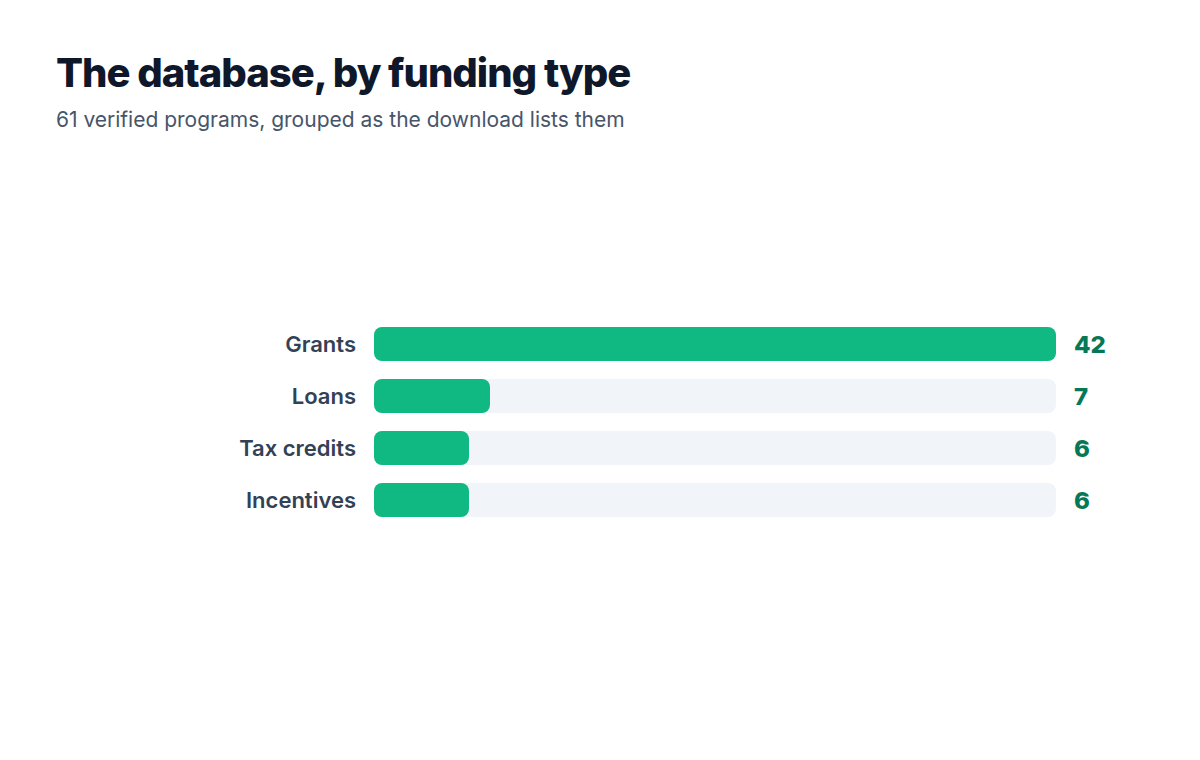
The Real Estate Grant Stack is a $49 downloadable toolkit that keeps that checklist, the program database with verified links, the application templates, and the timelines in one place — so you can qualify a property in minutes instead of researching from scratch each time.