Historic Tax Credit for Flippers
GrantEstate · 5 min read
By Donato Stough, founder of GrantEstate in Flower Mound, Texas. Every program cited here links to its official source page — each was checked against the agency’s own site before it went in. More about why I built this →
The federal historic credit is 20% of qualifying rehab work, but it is built for income-producing buildings. Here is when a flip qualifies and when it does not.
Short answer: The federal historic rehabilitation credit is 20% of qualifying work on a certified historic building, but it applies to buildings used in a trade or business or held to produce income. A straight flip, held briefly and sold to an owner-occupant, usually does not qualify. A flip you keep as a rental often does.
This is the most expensive misunderstanding in older-house flipping. People hear "20% tax credit" and assume it follows the building. It follows the building's use.
Get the use right and the credit can be worth more than the equity you were going to raise. Get it wrong and you find out at tax time, after the money is spent.
Does the historic tax credit work for a flip?
Usually not, and the reason is structural rather than bureaucratic.
Our database entry records the credit as 20% of qualified rehabilitation expenditures for certified historic structures, requiring three-part certification through the National Park Service and your State Historic Preservation Office, and applying to the building rather than the land.
The piece that decides flips is the income requirement. The credit is designed for a building used in a trade or business or held for the production of income. A house you buy, renovate, and sell to a family is inventory, not an income-producing asset, so the rehab is generally the wrong structure for the credit.
Confirm this with a tax adviser who has claimed the credit before you buy. It is a fact about your specific holding period and exit, and it changes the entire economics of the deal.
When does a flipper actually qualify?
When the exit is a rental rather than a sale — or when you hold the building for a business use.
- You renovate and keep it as a rental. The building is held to produce income, which is the use the credit is built around, and the certification path is the same one every adaptive-reuse developer walks.
- You convert a larger building — a downtown commercial building, a former school, a warehouse — into apartments or mixed use. Our entry describes this as the most important single incentive for adaptive reuse, and it is where most of the dollars actually move.
- You syndicate the credit. The entry notes credits may be syndicated for cash, often at a discount per credit dollar, which is how developers turn a tax credit into construction money. That requires an investor with tax liability, so it is a financing decision, not a filing detail.
If none of those describe your deal, the credit is not your money.
What does the certification process cost you in time?
More than most first-timers plan for, and the timeline is the part that kills deals.
Three-part certification runs through the National Park Service and your State Historic Preservation Office: the building is certified, the rehabilitation is reviewed, and the completed work is certified. Our entry is explicit that this is a required process rather than a formality.
Two practical consequences for a flipper.
Ask before you close. Whether the building is certified historic is a question for your SHPO, and the answer can change your basis by 20% of the rehab. Learning it after closing is an expensive way to find out.
Plan the timeline into the schedule. A certification sequence is not a weekend task, and a hard-money lender with a six-month clock does not care that your credit is coming in eighteen months.
What can a flipper use instead?
If the credit does not fit, these do — and the first two are actually accessible to a small operator.
- Local rehabilitation programs funded through Community Development Block Grant money (HUD Exchange) — the eligible activities include housing rehabilitation, and the money is administered by your city or county, which means the rules that matter are local. Local re-grants commonly run from roughly $50,000 to $1,000,000 depending on the jurisdiction.
- Utility rebates (DSIRE) — non-competitive money for HVAC, lighting, and appliance work you were doing anyway. Most programs require pre-approval before equipment is purchased or installed.
- Lead paint and healthy homes programs (HUD) — if the house predates 1978, local programs funded by HUD commonly cover assessment and abatement, which is a real cost on an older flip.
- The SBA 504 program — worth knowing that it is not available for investment property, so it does not fund a flip even though it funds owner-occupied buildings.
Read the flipping guide for how these fit into a project budget, and state and local programs before assuming nothing exists near you.
The short version
The 20% federal historic credit is real, large, and usually the wrong tool for a flip, because the building has to be used in a business or held to produce income. Keep it as a rental, convert a larger building, or syndicate the credit, and it becomes one of the best sources of non-dilutive money in older real estate. Otherwise, look at local rehabilitation programs, rebates, and lead paint funding — and get the certification question answered before you close.
Where to check this yourself
The primary sources behind this article are listed below. Program terms change, so confirm the current cycle and eligibility at the source before you rely on anything here.
- National Park Service — tax incentives for historic preservation — U.S. Department of the Interior
- HUD Exchange — Community Development Block Grant — U.S. Department of Housing and Urban Development
Both are maintained by the agency that runs the program, not by us.
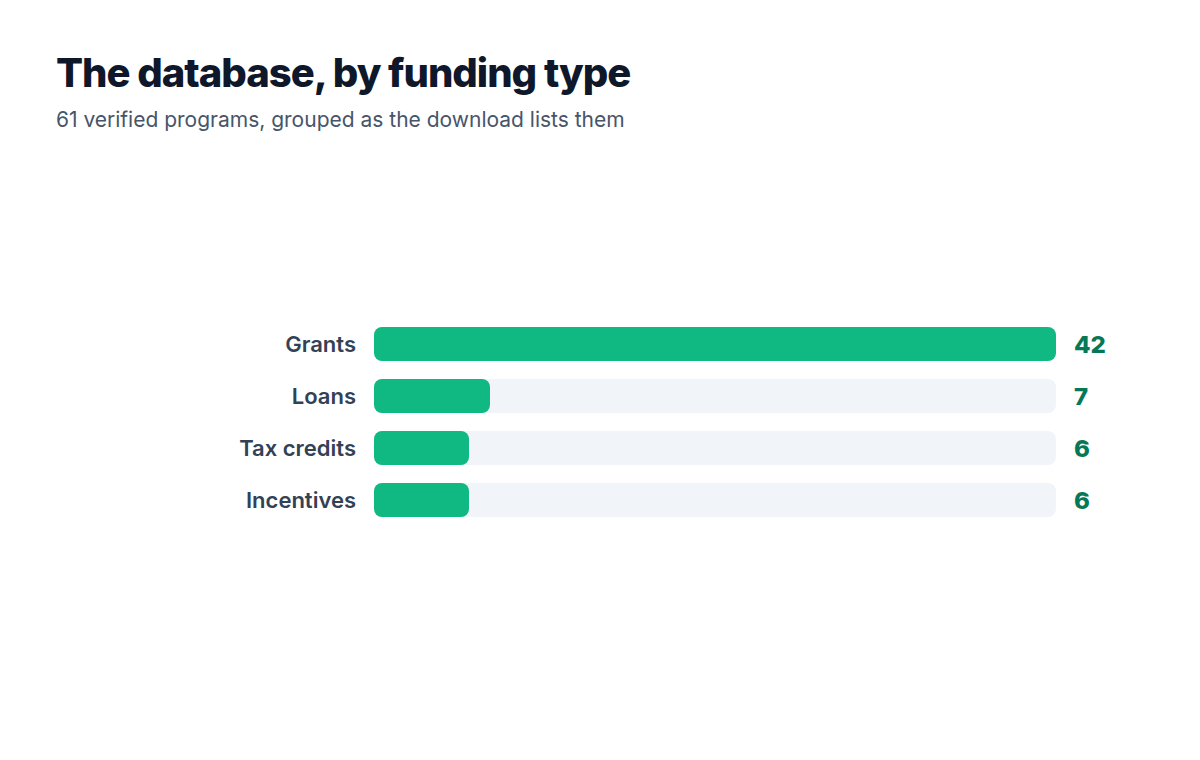
The Real Estate Grant Stack is a $49 downloadable toolkit that lists the 61 programs a property business can actually apply for, with the funding type and an official link on every entry — so you can tell a credit from a grant from a loan before you build a deal around it.