Lead Paint Grants for Landlords
GrantEstate · 4 min read
By Donato Stough, founder of GrantEstate in Flower Mound, Texas. Every program cited here links to its official source page — each was checked against the agency’s own site before it went in. More about why I built this →
HUD-funded local programs often pay for lead paint assessments and abatement in pre-1978 rentals at no cost to the owner. Here is how landlords get in.
Short answer: If your rental was built before 1978, HUD-funded local programs commonly pay for lead paint risk assessments and abatement at no cost to the owner, and landlords participate in a funded program rather than applying for a grant of their own. It is the least-known free money in older housing stock.
Lead paint is the cost that shows up in every old-house budget you did not plan for, and it is the one cost somebody else will often pay.
The reason is that lead poisoning is a public health failure, not a landlord problem. That makes it fundable in a way that a new roof is not.
Why would a program pay to fix my rental?
Because the money is aimed at the tenant's health, and your building is where the hazard is.
Our database entry on HUD's Lead Hazard Control and Healthy Homes grant programs describes the programs as highly relevant to landlords and renovators of pre-1978 housing, and notes that local programs funded by HUD commonly offer free lead paint risk assessments and abatement.
The companion entry on the Healthy Homes Production Grant Program adds the shape of it: historic awards in the range of $1,000,000 to $2,000,000 per grantee, covering remediation across multiple homes, funds hazards beyond lead — mold, pests, injury hazards — for low-income households, and notes that for a landlord the practical route is participating as a partner in a grantee's program.
So the answer to "how do I apply" is usually: you do not. You find the grantee.
How do you get in?
By finding the agency in your area that already holds the money.
- Your city or county health department is the most common grantee for lead hazard control work, and it is the first call to make.
- Your state health or housing agency administers or coordinates the programs where local capacity is thin.
- A community development organization or housing nonprofit in your market is often a sub-recipient doing the actual remediation work.
- Your local CDBG administrator (HUD Exchange) knows which HUD money is active locally, because the same office usually touches both.
Ask a specific question: which properties are you funded to remediate this year, and how does an owner get on the list. Programs are usually scoped by geography and income, so the honest answer may be that your block or your tenant mix does not qualify — better to learn that in a phone call.
Who has to qualify — me or my tenant?
Your tenant's income, usually, because the programs are built around low-income households.
That means a pre-1978 rental with higher-income tenants may not be eligible, while a similar building next door is. It also means a landlord with a mixed portfolio can often get the older, lower-income units addressed and not the others.
The remediation itself is typically performed by the program's contractors at no cost to the owner, and the entry notes whole homes are often remediated for income-eligible occupants. Confirm what your local program covers, because the scope varies by grantee.
Does this help beyond the paint?
Yes, and that is why landlords who learn about it tend to use it repeatedly.
- It removes a legal exposure. Lead disclosure and remediation obligations are a real liability in pre-1978 housing, and a documented, professionally abated unit is defensible in a way that a coat of paint is not.
- It overlaps with other programs. Healthy Homes money covers hazards beyond lead, and the same grantees often run weatherization or rehabilitation programs that can touch the same building.
- It is stackable with your own plan. If you are already renovating, timing the renovation around a funded assessment can absorb a cost you were about to carry yourself.
For the wider picture on older properties, read the historic rehabilitation credit guide — certification and abatement questions often arrive in the same phone call.
The short version
Lead paint is the most fundable deferred-maintenance problem in older rental housing, because the money exists to protect tenants rather than to help owners. Landlords do not apply for it; they find the local health department, housing agency, or nonprofit that already holds a HUD grant and get their units into the program, usually at no cost. If your rentals predate 1978, this is worth an hour of phone calls before you budget another dollar for paint.
Where to check this yourself
The primary sources behind this article are listed below. Program terms change, so confirm the current cycle and eligibility at the source before you rely on anything here.
- HUD Office of Lead Hazard Control and Healthy Homes — U.S. Department of Housing and Urban Development
- HUD Exchange — Healthy Homes programs — U.S. Department of Housing and Urban Development
Both are maintained by the agency that runs the program, not by us.
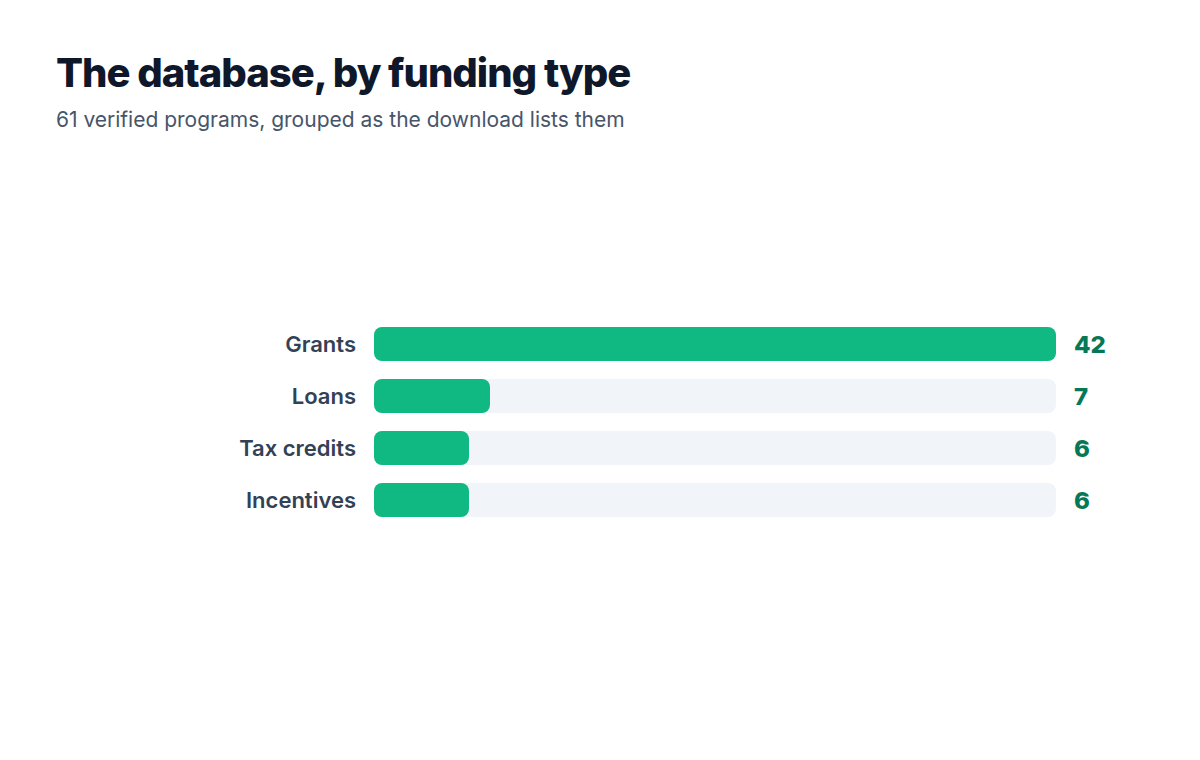
The Real Estate Grant Stack is a $49 downloadable toolkit with 61 real estate programs listed by what they fund and who is eligible, with an official link on every entry — including the ones you participate in rather than apply for.