Energy Rebates for Rental Properties
GrantEstate · 4 min read
By Donato Stough, founder of GrantEstate in Flower Mound, Texas. Every program cited here links to its official source page — each was checked against the agency’s own site before it went in. More about why I built this →
Utility rebates are non-competitive money for rentals, and most landlords lose them by installing first. Here is the pre-approval rule and where to search.
Short answer: Utility energy rebates are non-competitive money for rental properties — commonly a few hundred dollars per measure up to tens of thousands for a comprehensive retrofit — and most landlords lose them by installing equipment before applying. In rural areas, USDA's REAP program is one of the few federal grants a for-profit can apply for directly.
This is the easiest money in rental real estate and the most commonly forfeited, because the rule that decides it is boring and most owners learn it too late.
The rebate is not a reward. It is a purchase order, and it has to be issued before you buy.
Why do landlords lose rebates they qualify for?
Because most programs require approval before the work happens.
Our database entry on utility energy efficiency and demand reduction rebates is emphatic on the point: most programs require pre-approval before equipment is purchased or installed. The same entry describes the money as the most under-used in real estate — non-competitive, applying to work you were already doing, and often requiring nothing more than an application plus documentation.
The scale is real: commonly from a few hundred dollars per measure to tens of thousands of dollars for comprehensive commercial retrofits, with custom programs for larger projects based on measured savings.
Sign the contractor's proposal first and you have converted free money into a full-price project.
What kinds of work get rebated?
The measures that already cost you money in a rental.
- HVAC and water heating — replacements and controls, which most landlords are doing on a schedule anyway.
- Lighting — interior and exterior, including common areas and parking lot lighting, where the savings show up on your bill rather than the tenant's.
- Commercial kitchen and laundry equipment, for buildings that have it.
- Envelope and insulation work, and in some programs demand-reduction measures that lower peak load.
- Custom projects, where a larger retrofit is underwritten against measured savings rather than a fixed per-item table.
How do you find the programs that apply to your building?
Search by ZIP code, because utility service territory is what decides this, not the state you live in.
DSIRE is the standard national database of utility, state, and local incentives, and our database entry calls it the single most useful free research tool in the set. Search it early and often, and note that a building on one side of a street can have a different utility and a different rebate than the building across it.
Then check two more things.
- Whether your utility wants an energy assessment first. Some custom programs require one, and it is usually free or subsidized.
- Whether the rebate is paid to the account holder or the owner. Our entry notes most commercial and multifamily customers are eligible, and that rebates are typically paid to the account holder or property owner — so if tenants pay the utility, sort out who files before you spend.
What about rural properties?
There is a real federal grant here, and it is unusual because a for-profit can apply directly.
The Rural Energy for America Program (USDA Rural Development) is described in our database as one of the few federal grants a for-profit rural business can apply for directly. It has historically covered up to 25% of project cost with awards commonly in the $1,500 to $500,000 range, it requires an energy assessment or audit for efficiency projects, and grant-and-guaranteed-loan combinations are common.
Program rules, deadlines, and percentages change, so verify the current terms — but if you own rural rentals, this is the one to check.
For benchmarking and technical resources, ENERGY STAR for buildings is the free starting point our database lists for commercial buildings.
The short version
Utility rebates are non-competitive, available on work you were doing anyway, and forfeited mainly through timing: apply before you install. Search DSIRE by ZIP code, confirm who receives the payment, and stack rebates with the rest of your capital plan rather than treating them as an afterthought. If your property is rural, add USDA REAP to the list.
For the wider toolkit on older buildings, see the historic credit guide and the landlord funding guide.
Where to check this yourself
The primary sources behind this article are listed below. Program terms change, so confirm the current cycle and eligibility at the source before you rely on anything here.
- DSIRE — Database of State Incentives for Renewables and Efficiency — North Carolina State University, funded by the U.S. Department of Energy
- USDA Rural Development — energy programs (REAP) — U.S. Department of Agriculture
Both are maintained by the organizations that run the programs, not by us.
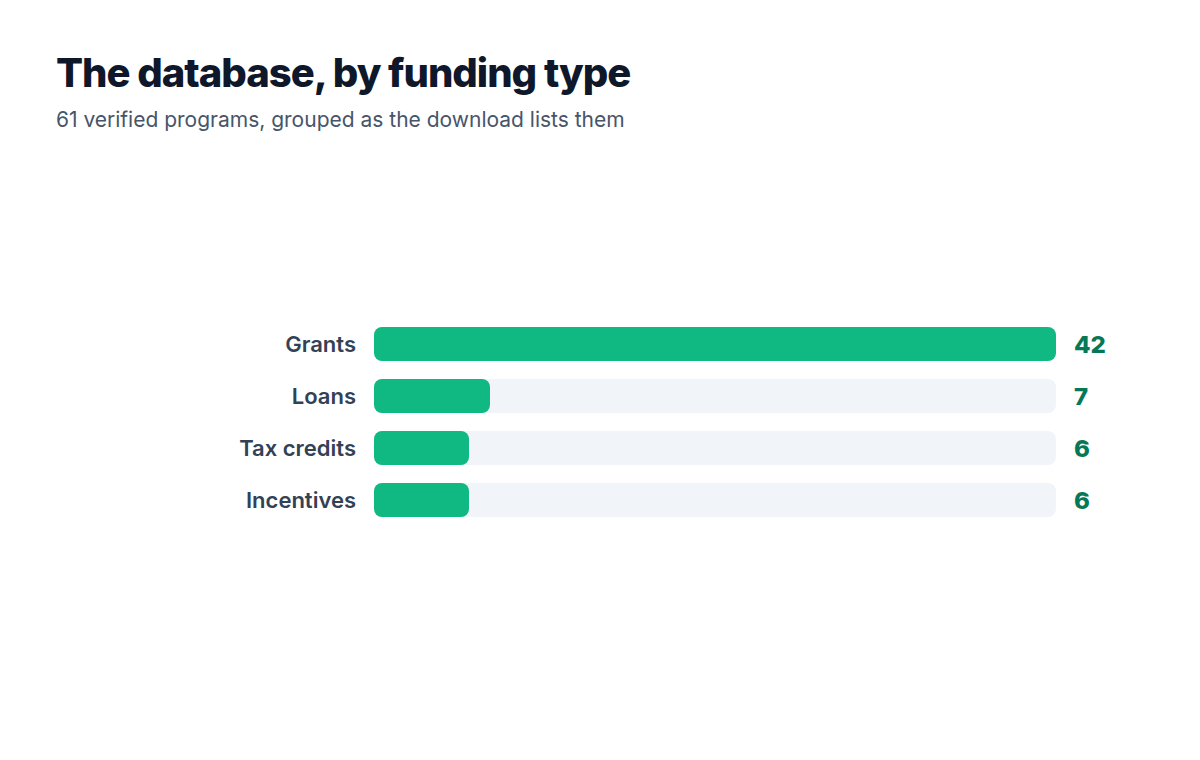
The Real Estate Grant Stack is a $49 downloadable toolkit with 61 real estate programs, including the incentive and rebate programs that never appear on a grant list, with an official link on every entry.