Grants for Real Estate Investors
GrantEstate · 8 min read
By Donato Stough, founder of GrantEstate in Flower Mound, Texas. Every program cited here links to its official source page — each was checked against the agency’s own site before it went in. More about why I built this →
Most investor grants are really loans or marketing. Here is what genuinely exists for property investors, and where the real non-dilutive money flows.
Short answer: Very few grants exist for real estate investors as investors. What exists is money tied to a specific property or public purpose: energy rebates, brownfield cleanup funding through regional loan funds, historic tax credits, and affordable housing capital. Everything else marketed as investor grant money is a loan.
Search "grants for real estate investors" and you will find a lot of confident articles listing programs that turn out, on inspection, to be loans, or hard-money lenders, or sales funnels, or programs that were discontinued years ago.
This article is the honest version. It explains what genuinely exists for investors, why pure "investor grants" are scarce, and where non-dilutive money actually flows if you own or are buying property.
Why "investor grants" are scarce
Grants exist to buy a public benefit that the market will not produce on its own. Programs are written around outcomes like affordable housing, cleaned-up contaminated land, preserved historic buildings, reduced energy use, and job creation.
Owning an investment property is a private benefit. Buying a rental at market price and renting it at market rent does not, by itself, produce the kind of outcome a grant program was created to buy.
That is the entire reason the phrase "grants for real estate investors" leads mostly to dead ends. It is not that grants are unavailable to people who invest in real estate. It is that the grant is attached to the outcome, not to your status as an investor.
The practical consequence: instead of asking "what grants are there for investors?", ask "what public benefit could this property produce, and which program pays for that?" Those are very different questions, and the second one has answers.
What genuinely exists for real estate investors?
Tax credits and tax incentives
These are usually the largest non-dilutive dollars available to an investor, and they are not grants.
The federal historic rehabilitation tax credit applies to income-producing certified historic structures — which includes rental housing, hotels, and commercial buildings. It is worth researching seriously if you are looking at any pre-1960s building in a historic district. Many states also run their own historic credit, and state credits are often more usable on smaller projects.
The low-income housing tax credit is the main engine of affordable rental development in the United States, allocated competitively by each state's housing finance agency. For-profit developers are major participants, and the credit is typically syndicated to investors for cash that funds a large share of a project.
Other federal incentives cover energy efficiency in commercial buildings, energy-efficient homes, and solar. Rules and rates in this area have changed repeatedly with new legislation, so confirm current terms with a tax advisor rather than a website.
Local incentives: TIF, abatement, and PILOT
Tax increment financing, tax abatement, and payments in lieu of taxes are negotiated with your city or county. They are not competitive applications; they are deals.
They matter most where a project would not otherwise happen — a blighted site, a downtown building, a former industrial parcel, or a project the locality wants for its own reasons. They require a political process: a public hearing, often a council vote, and a clear story about what the project does for the community.
Facade, rehabilitation, and neighborhood programs
Many cities and counties run small programs for exterior improvements, code compliance, and rehabilitating distressed housing, often funded with federal block-grant dollars. Awards tend to be modest, and the terms vary enormously — some are grants, some are forgivable loans, some are low-interest loans.
These are worth knowing about, because they are frequently non-competitive or lightly competitive, and because the staff who run them know about other local programs.
Brownfield assessment and cleanup
If your property has environmental contamination — a former gas station, dry cleaner, auto shop, or industrial use — this is one of the most genuinely fundable situations in real estate. Federal and state brownfield programs fund assessment and, in some cases, cleanup.
Note the eligibility structure: the grant is often made to a state, local government, or nonprofit, with the site owner or developer participating as a partner. There are also revolving loan funds that lend directly to owners and developers.
Utility energy efficiency rebates
Non-competitive, applied to work you were already going to do, and the single most under-used money in small real estate. HVAC, insulation, lighting, controls, appliances, refrigeration, and motors all typically qualify.
The one rule that catches people: most programs require approval before you purchase or install the equipment. Buy first and ask after, and you will be told no.
Search DSIRE (dsireusa.org) by ZIP code to find programs in your area, then call your utility's commercial account representative directly. They have programs that are not heavily advertised.
Below-market and soft loans
Not grants, but genuinely non-dilutive and often the difference between a deal working and not. State housing finance agencies, community development financial institutions, and federal programs like SBA 504 and 7(a) all offer capital on terms conventional lenders will not match.
A 1% loan over 30 years with a deferred payment period behaves, in the capital stack, a lot like equity. If your goal is simply to avoid giving away ownership, soft debt can accomplish the same thing that a grant would.
Federal Home Loan Bank Affordable Housing Program
If your project includes affordable units, this is one of the most practical grant sources available to a for-profit developer — and almost nobody uses it. The application is made by a member bank on behalf of the project, so the route in is a relationship with a bank.
The single highest-leverage question you can ask your commercial banker is whether your project qualifies for their community development lending or a Federal Home Loan Bank application.
Opportunity Zones
A capital gains tax incentive rather than a grant. The benefit goes to the investor who puts eligible gains into a qualified fund, which means developers attract Opportunity Zone capital by structuring an investment rather than by applying for anything.
The rules and available benefits have been modified by legislation over time. Treat this as an area where you need current tax advice, not a blog post.
The honest summary
- Cash for buying a rental at market price — essentially nothing.
- Money for a historic building rehab — federal and state historic tax credits, sometimes facade grants.
- Money for contamination cleanup — brownfield assessment and cleanup programs, and revolving loan funds.
- Money for energy upgrades — utility rebates, state energy programs, and C-PACE financing.
- Money for affordable units — low-income housing tax credits, HOME funds, housing trust funds, and the Federal Home Loan Bank AHP.
- Money for a blighted or distressed property — local TIF, abatement, blight programs, and land bank dispositions.
- Capital without giving up equity — soft loans, SBA programs, CDFI lending, and C-PACE.
Notice the first item. It is the one entry on this list that does not exist anywhere, and it is the answer most articles avoid giving.
How do you find programs you qualify for?
Stop searching for grants and start listing what your specific property could produce. Ask:
- Is it historic, or in a historic district?
- Is it contaminated, vacant, or blighted?
- Could it produce affordable units?
- Does it waste energy?
- Is it in a rural area?
- Would it create permanent jobs?
Each yes points at a different set of programs.
Then work the four layers in order: federal, state, local, and utility.
Our main guide to how real estate grants work walks through each funding source in more detail, and the state-by-state guide explains how to find what your state offers. Before you commit a weekend to this, it is worth understanding whether grants have to be repaid — the answer is more nuanced than most people expect.
The short version
There is no meaningful category of grants for buying investment property at market price. There is a substantial amount of non-dilutive money for properties that produce a public benefit — affordable units, contamination cleanup, historic rehabilitation, energy savings, job creation, and blight removal.
The work is matching your property to a benefit, and then to a program that pays for it. That
Where to check this yourself
The primary sources behind this article are listed below. Program terms change, so confirm the current cycle and eligibility at the source before you rely on anything here. Program terms change, so confirm the current cycle and eligibility at the source before you rely on anything here.
- SBA 7(a) loan program — U.S. Small Business Administration
- Opportunity Zones — Internal Revenue Service
Both are maintained by the agency that runs the program, not by us.
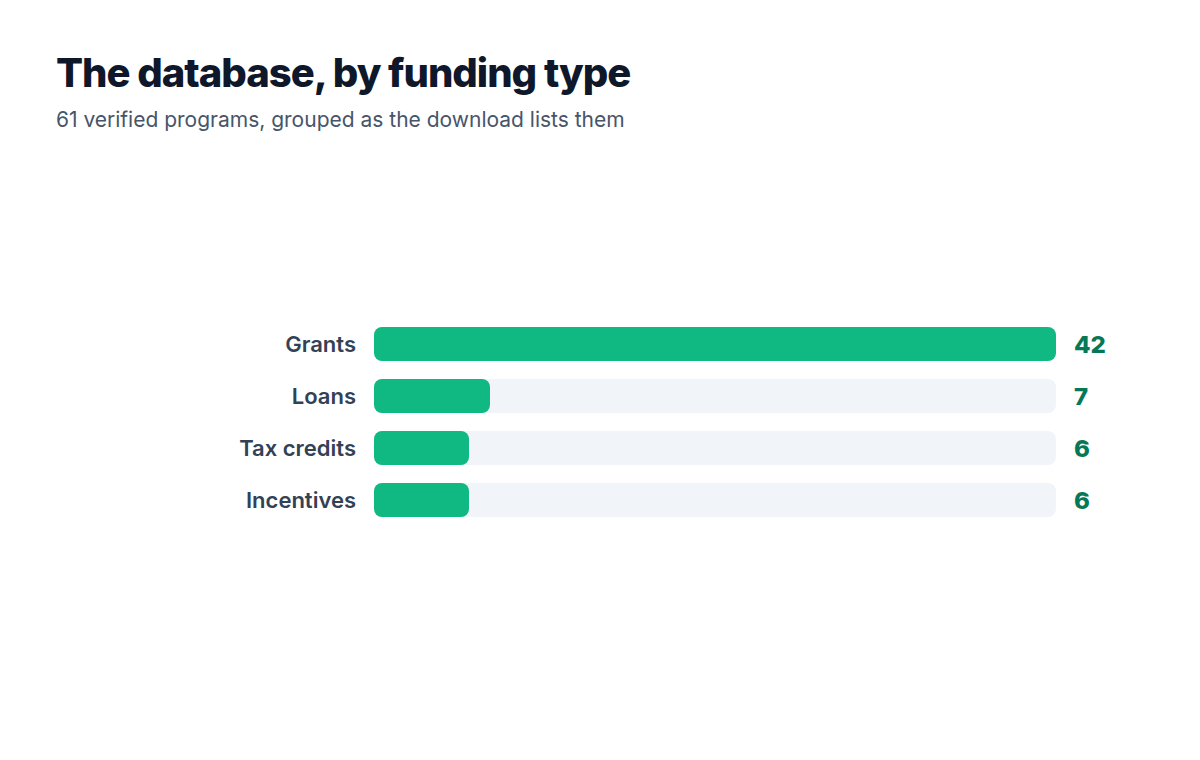
matching is the tedious part. The Real Estate Grant Stack is a $49 downloadable toolkit built to shortcut it: a step-by-step playbook, a database of real programs with verified links, a bank of application templates, and an annotated swipe file of strong application writing.