Grants for Landlords: What Exists
GrantEstate · 8 min read
By Donato Stough, founder of GrantEstate in Flower Mound, Texas. Every program cited here links to its official source page — each was checked against the agency’s own site before it went in. More about why I built this →
Landlords rarely qualify for grants on their own, but the property, the tenants, and the utility meters often do. Here is what exists and what it costs you.
Short answer: There is no federal grant for owning a rental property at market rent. The money that does reach landlords pays for what the property does or who lives in it: utility rebates, lead paint and healthy homes work, city rehabilitation programs, and affordable housing capital.
Here is the honest version first: there is no federal grant for owning a rental property at market rent.
That is not a problem with your searching. It follows from what grant money is for. Public money buys a public benefit the market will not produce on its own: affordable housing, a cleaned-up site, a preserved landmark, a stabilized block. Owning a duplex and collecting market rent is a private business doing what private businesses are supposed to do.
So most of what you find when you search for landlord grants is one of three things: a loan with a friendlier name, a coaching program, or a list scraped off a HUD page that has not been updated in a decade.
The flat answer is not the whole answer, though. Money does reach landlords — through the property, through the tenants you serve, and through the utility meters you pay every month. This page covers the routes that actually exist, and the trade-off attached to each one.
Why does the property's condition matter more than the program?
Every real source of money for a rental property owner attaches a condition to one of three things. Decide which of the three you will accept before you research a single program, because most landlord disappointment comes from wanting the money without the condition.
- Who lives there. Income-restricted housing programs. This is where the largest money is, and it carries the most compliance and the longest commitment.
- What the building was. Historic rehabilitation tax credits and environmental cleanup programs. These attach to the property's history rather than to your rent roll.
- What the building costs to operate. Utility rebates and efficiency financing. No income restrictions, no tenant screening requirements, and by far the easiest money on this page to collect.
Which utility rebates are the easiest money?
Your utility — investor-owned or municipal — very likely runs a rebate program for efficiency upgrades, and most commercial and multifamily customers are eligible. Rebates commonly run from a few hundred dollars for a single measure to tens of thousands of dollars for a comprehensive commercial retrofit. Payments typically go to the account holder or the property owner, which is you.
This is the most under-used money in residential rental property, for a simple reason: it is non-competitive. There is no round, no scoring rubric, and no other applicant to beat. The work qualifies or it does not. It also applies to things you were going to do anyway — the failing HVAC unit, the roof, the lighting in the common areas, the water heater.
There is one rule that catches people constantly: most programs require pre-approval before the equipment is purchased or installed. Landlords routinely replace a furnace, keep the invoice, and then discover the rebate was forfeited because the application came second. Ask about the program before you authorize the work, not after.
Rebate programs are administered locally, so availability depends on your utility's service territory. Search your ZIP code and utility name in a national incentive database and confirm your utility's current program terms directly.
Is there money for lead paint and healthy homes?
If you own housing built before 1978, this is the second category worth checking, and it is persistently overlooked.
HUD's Office of Lead Hazard Control and Healthy Homes and its Healthy Homes Production grant program fund the identification and remediation of health and safety hazards — lead paint, mold, pests, injury hazards — in the homes of low-income households. The awards themselves go competitively to state and local governments, Tribes, and nonprofits that operate programs. Individual landlords do not apply for these grants, and this is the part that matters:
Property owners participate through the local program, frequently at no direct cost to them. Local lead programs commonly provide free risk assessments and abatement for income-eligible occupants.
For a landlord, that is close to free capital. The route in is your city or county health department, not the federal government. Ask whether they run a lead hazard control program, what the occupant income limits are, and how a property owner gets on the list.
How do you get rehabilitation money through your city?
Community Development Block Grant funds are allocated by formula to entitlement communities — larger cities and counties — and to states for smaller communities. A private developer or landlord does not apply to HUD. You apply to your city or state, which re-grants or lends the money onward. Local re-grants to property owners commonly run from roughly $50,000 to $1,000,000 or more, depending on the jurisdiction's allocation.
The catch is the national objective: CDBG money must principally benefit low- and moderate-income persons. Common eligible activities include housing rehabilitation, acquisition, public facilities and improvements, and site improvements. In practice, that means some cities run owner-occupied rehab programs, some run rental rehabilitation programs tied to income-restricted units, and some fund neither. It genuinely varies by jurisdiction, and the only way to know is to ask.
The same structure applies to the HOME Investment Partnerships Program, which participating jurisdictions use for affordable rental and homeownership housing. HOME is restricted to households generally at or below 80% of area median income, with deeper targeting for rental, long affordability periods, and a requirement that at least 15% of a jurisdiction's allocation go to nonprofit or community housing development organization projects. Project awards commonly run from $250,000 to several million dollars.
Section 108 covers larger deals: a city borrows against its future CDBG allocation with a federal guarantee and lends the proceeds onward. It is a loan guarantee, not a grant.
What if you will accept income limits?
This is the honest fork in the road for a landlord. The programs below are the real engine of American rental housing finance, and for-profit developers participate in all of them. What they require is that the units serve households below certain incomes, for a defined period, at rents you do not set freely.
- Low-Income Housing Tax Credit. Allocated competitively by each state's housing finance agency in an annual round. Equity raised through syndication commonly funds 30% to 70% of total development cost. For-profit developers are eligible and are major participants.
- National Housing Trust Fund. Targeted to rental housing for extremely low-income households, generally at or below 30% of area median income. Allocated by formula to states, and often used as gap financing alongside tax credits.
- Federal Home Loan Bank Affordable Housing Program. Competitive awards commonly in the range of a few hundred thousand to over a million dollars per project. The application is made by a Federal Home Loan Bank member bank on behalf of a project, so a developer partners with a member bank rather than applying directly.
- State housing finance agency programs. Your state agency is typically the single most important funding relationship available to a rental developer — it allocates tax credits, issues tax-exempt bonds, and runs gap financing and soft-second loan programs.
If you are not willing to accept rent and income restrictions, stop reading this section and go back to the utility rebates. That is not a moral judgment; it is the actual trade.
What does not exist for landlords?
- There is no federal grant that pays your down payment, your mortgage, or your acquisition costs on a market-rate rental.
- The SBA does not make general real estate grants. Treat any offer of an "SBA grant for real estate" with heavy skepticism and verify it against the SBA's own funding pages.
- The Neighborhood Stabilization Program is a historic program with no new rounds. NSP-style stabilization dollars sometimes reappear, and unspent funds occasionally remain with a locality, so it is worth a question — but not a plan.
- Anything charging an application fee to release a grant award is not a grant program.
The short version
Market-rate landlording is not a grant-fundable activity, and no amount of research changes that. But four things are: the energy your building wastes, the hazards in your pre-1978 units, the condition of the neighborhood your property sits in, and the income of the tenants you are willing to serve.
Claim them in that order. Utility rebates first, because they require nothing of your business model and merely require you to ask before you buy. Then the local lead and rehab programs, which are small but real and usually free to you. Then, if you want the serious money, decide whether you will accept income and rent restrictions and go talk to your state housing finance agency.
If you want the version of this for investment property generally, read grants for real estate investors. Before you sign anything a program sends you, understand what can claw the money back.
Where to check this yourself
The primary sources behind this article are listed below. Program terms change, so confirm the current cycle and eligibility at the source before you rely on anything here. Program terms change, so confirm the current cycle and eligibility at the source before you rely on anything here.
- Office of Lead Hazard Control and Healthy Homes — U.S. Department of Housing and Urban Development
- HOME Investment Partnerships Program — U.S. Department of Housing and Urban Development
Both are maintained by the agency that runs the program, not by us.
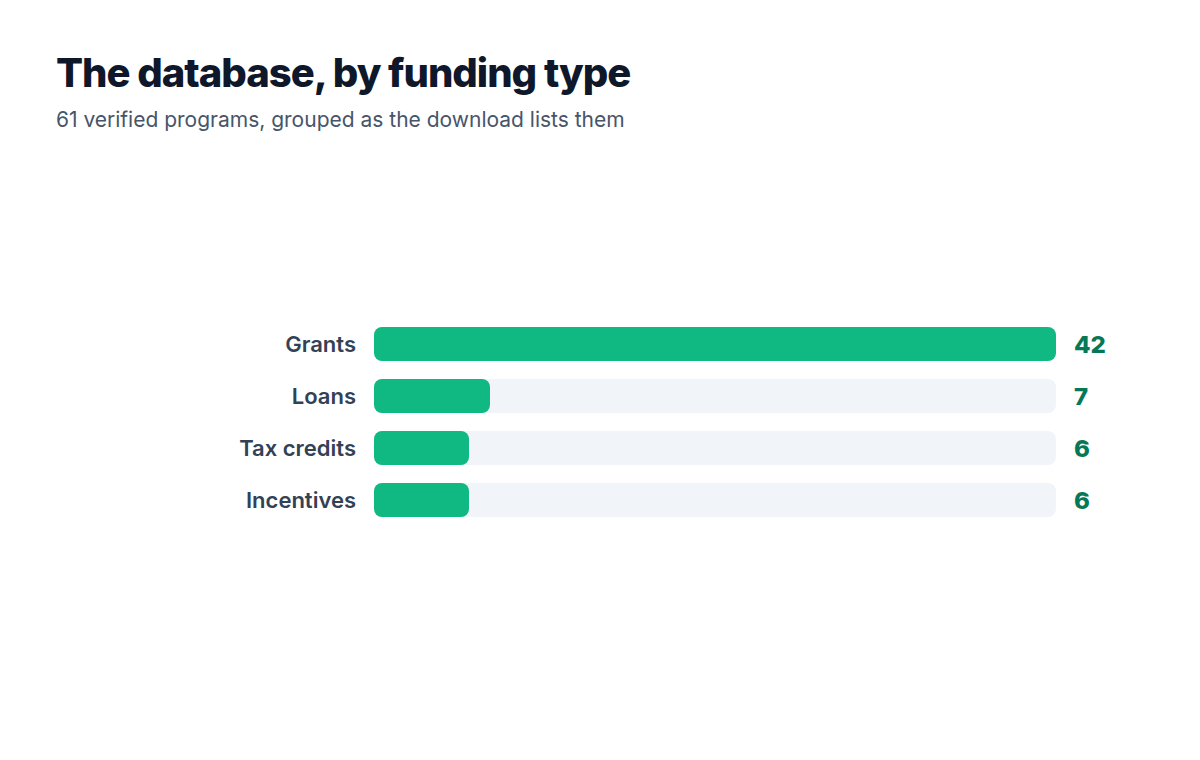
The Real Estate Grant Stack is a $49 downloadable toolkit that keeps this checklist, the database of real programs with verified official links, the application templates, and the timelines in one place — so you can work out which of these you qualify for in an afternoon instead of a month.