How to Apply for a Real Estate Grant
GrantEstate · 7 min read
By Donato Stough, founder of GrantEstate in Flower Mound, Texas. Every program cited here links to its official source page — each was checked against the agency’s own site before it went in. More about why I built this →
A practical walkthrough of the grant application process, from finding programs and checking eligibility to assembling attachments and submitting on time.
Short answer: Applying for a real estate grant is mostly a qualification exercise. Check eligibility before you write, call the program officer, map your answers to the published scoring rubric, start the attachments immediately, and submit early. The writing is the easy part.
Most people who fail at grant applications fail before they write a word. They apply to a program they were never eligible for, or they miss a deadline waiting on an attachment, or they write a beautiful narrative that asks for the one thing the program will not pay for.
This is the process, in the order that avoids those mistakes.
Step 1: Where do you find programs worth applying to?
Do not start by searching "real estate grants." Start with what your project produces.
Write one sentence: "This project delivers [benefit] for [people or place], measured by [metric]." Contaminated site cleanup. Affordable units. A preserved historic building. Measured energy savings. Permanent jobs. Blight removal. That sentence determines which programs are even relevant.
Then work four layers:
- Federal — grants.gov. Create an account, set saved searches with email alerts, and check monthly. Most federal real estate capital reaches you through state and local programs rather than directly, so do not stop here.
- State — your housing finance agency, historic preservation office, energy office, and economic development department.
- Local — your city or county community development and economic development departments.
- Utility — DSIRE (dsireusa.org), then a call to your utility's commercial account rep.
Aim for a list of eight to fifteen candidates. You will cut most of them in the next step.
Step 2: How do you know you qualify?
Run each candidate through these screens, in order, and stop at the first failure.
Are you an eligible applicant? Read the "Eligible Applicants" section of the guidelines, not the marketing page. Many programs are restricted to governments, nonprofits, or housing authorities. If you are a for-profit LLC and you are not on the list, work out whether you can partner with someone who is — before you invest any writing time.
Is a round open, and can you make the deadline? Count business days, not calendar days. Then subtract time for signatures, third-party attachments, and internal review.
Do your activities match the eligible activities list? Programs name specific things: acquisition, rehabilitation, construction, remediation, energy improvements, facade work. Match literally.
Can the money legally pay for your costs? This screen kills more applications than any other. Land acquisition, refinancing existing debt, developer fees, and working capital are frequently ineligible. If your entire gap is in an unallowable category, stop.
Can you meet the match and the terms? Match requirements, affordability periods, prevailing wage, and use restrictions. If match is required, identify the source and get a written commitment before you apply — not after.
A short list of three or four programs you genuinely qualify for is worth more than twenty maybes.
Step 3: Call the program officer
Five minutes on the phone routinely saves weeks of wasted work. Ask:
- Given your project, is this a program you should be pursuing at all?
- Is there a list of last round's awards you can look at? It shows real award sizes and recipient types, and it is public information in most programs.
- What are the most common reasons applications get rejected?
- Will there be another round, and approximately when?
Read the guidelines first, so your questions are specific. Do not ask them to do your research for you — ask about the paragraph you could not resolve.
Step 4: Build the rubric map
Take the scoring criteria out of the guidelines and put them in a spreadsheet: one row per criterion, and four columns for the criterion itself, the points available, where in your application you answer it, and the evidence you are attaching.
Then allocate your writing time in proportion to the points. A criterion worth 25 points deserves five times the words of one worth 5.
Most applicants do the opposite: they write at length about whatever is easiest to write about, and skim the sections that actually carry the score.
If the rubric is not published, ask for it. It usually exists.
Step 5: Start the attachments immediately
Attachments are where applications die, and they are the part that depends on other people. Build the list from the guidelines' required-attachments section, then work backwards.
Common items with long lead times: site control documents, financial statements from your accountant, a bank term sheet, environmental assessments, appraisals, cost estimates, letters of support, insurance certificates. Several of these take two to six weeks.
Start every third-party item in week one. If something will not arrive in time, call the program officer and ask whether there is an alternative — do not simply omit it.
Step 6: Write in the order that avoids rewriting
Write the budget first, then the work plan and timeline, then the project narrative, then the statement of need, then sustainability and community impact, and the cover letter last.
This feels backwards. It is also the single biggest time-saver in the process, because it prevents the situation where you write a compelling narrative and then discover the numbers do not support it.
Three rules that apply to every section:
Specific claim, then number, then source, then date. Everything in the real estate grants overview about how funders evaluate need applies here: "rents are rising" scores nothing; "median rent rose from X to Y between 2023 and 2025, per ACS 5-year estimates" scores.
Use the funder's own section names and numbers, in their order. Never reorder or rename. A reviewer with a rubric scrolls to Section 4 and expects Section 4.
Never state a fact that is not true — including a readiness claim, or a commitment you have attributed to a partner or agency that has not actually authorized it.
Step 7: Quality control before you submit
Check these in order. Every one of them has sunk a real application.
- The dollar amount is identical in the cover letter, the budget, and the sources-and-uses table.
- Unit counts, square footage, addresses, and dates match everywhere they appear.
- The entity legal name matches your registration documents and tax filings exactly.
- Every required attachment is present, in the order the guidelines list them.
- Every rubric criterion is addressed explicitly, using its language.
- No page or word limits are exceeded — verified by counting, not estimating.
- Every number has a source and a date.
- No claim you cannot substantiate.
Then give the whole packet to someone who knows nothing about the project and ask them: what am I asking for, and why should a stranger fund this? If they cannot answer both, a reviewer will not either.
Step 8: Submit early
Upload at least 24 hours before the deadline. Submission portals fail on deadline day, and "the portal crashed" is not an accepted reason. Save a complete archive of exactly what you submitted, with the date.
Then start your next application. Do not wait for an answer — grant cycles are slow, and you cannot afford to idle for six months.
What happens after you submit?
Review takes months. If you are awarded, the agreement negotiation process takes several more, and if the grant is reimbursement-based you spend money before you are paid. If you are rejected, ask for reviewer feedback — it is the cheapest consulting available, and most rejected applicants never ask.
The short version
Qualify honestly first, write second. The screening step is where you win or lose, and writing skill cannot rescue a structural mismatch. Expect the whole cycle to take months, and expect to apply more than once.
If you want the eligibility screens, the budget structures, the templates, and the timelines in one
Where to check this yourself
The primary sources behind this article are listed below. Program terms change, so confirm the current cycle and eligibility at the source before you rely on anything here. Program terms change, so confirm the current cycle and eligibility at the source before you rely on anything here.
- SBA local assistance network — U.S. Small Business Administration
- Community Development Block Grant program — U.S. Department of Housing and Urban Development
Both are maintained by the agency that runs the program, not by us.
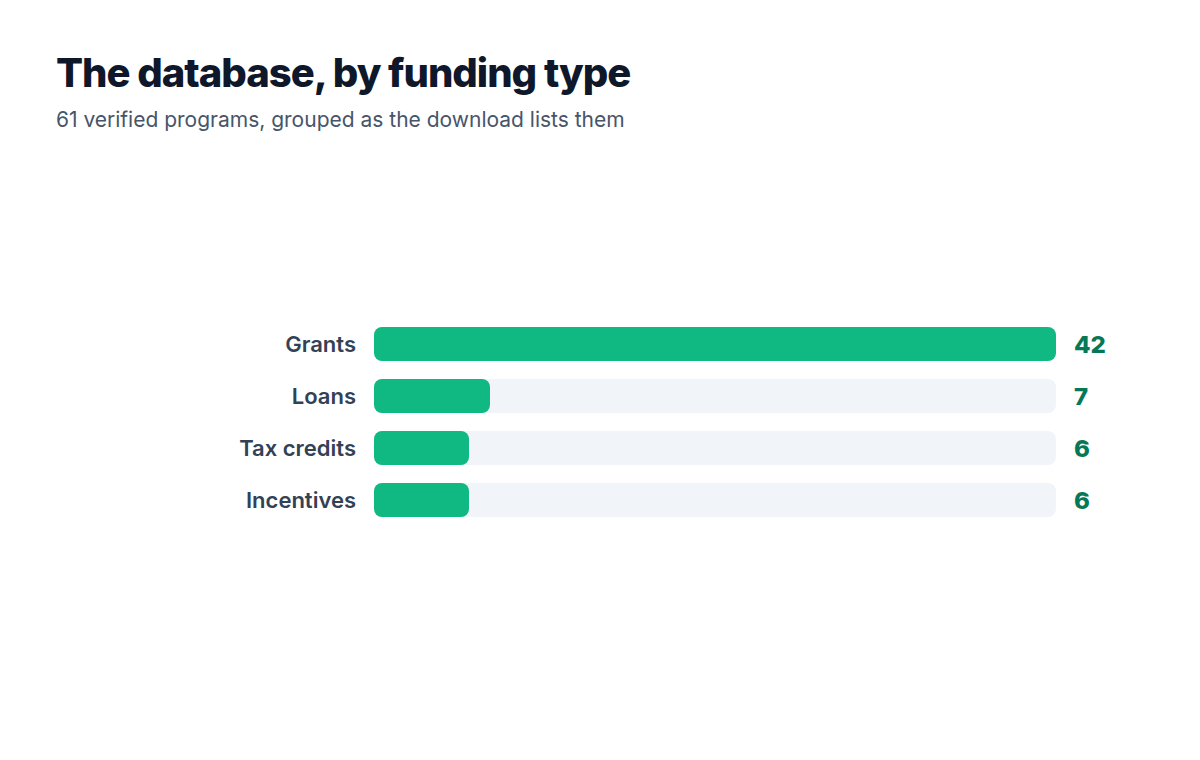
place rather than assembled from a dozen government websites, The Real Estate Grant Stack is a $49 downloadable toolkit built to do exactly that work: a step-by-step playbook, a database of real programs with verified links, a bank of application templates, and an annotated swipe file.