Real Estate Grants: How They Work in 2026
GrantEstate · 7 min read
By Donato Stough, founder of GrantEstate in Flower Mound, Texas. Every program cited here links to its official source page — each was checked against the agency’s own site before it went in. More about why I built this →
What real estate grants actually fund, who gives them out, who is allowed to apply, and how to find the programs you genuinely qualify for in your market area.
Short answer: A real estate grant is money for a property project that you do not repay, given because the project serves a public purpose. Most advertised real estate grants are loans, tax credits, or sales funnels. Real money comes from federal agencies, state housing and historic agencies, local governments, and utilities.
If you have spent an evening searching for "real estate grants," you have probably found three things: a lot of promises, very few actual programs, and no clear explanation of how any of it works.
This is that explanation. It covers what grants fund, who hands them out, who is allowed to apply, and what you should realistically expect — including the parts most websites leave out.
What is a real estate grant, exactly?
A grant is money awarded to accomplish a public purpose. You do not repay it, and you do not give up equity. In exchange, you accept obligations: you must spend the money on the approved purpose, document every dollar, report on your progress, and follow the funder's rules about how you hire, build, and operate.
That trade — money for compliance — is the whole deal. Grants are not free in the sense of costing nothing. They are free in the sense of not being debt or equity.
The five kinds of money people call "grants"
Most confusion about real estate grants comes from lumping five very different instruments together. Sorting them out changes how you search.
True grants. Cash for a public purpose. Not repaid.
Below-market loans. Real debt, but on terms a bank would not offer — low interest, long amortization, deferred payments, or forgiveness if you meet conditions like keeping units affordable for a set period. In practice, a 1% loan over 30 years behaves a lot like equity.
Tax credits. A dollar-for-dollar offset against taxes owed. Some, like the federal historic rehabilitation credit, can be sold to investors for cash and used as equity in your project. Credits only help if you have tax liability or can syndicate them.
Local incentives. Tax abatement, payments in lieu of taxes, tax increment financing, fee waivers, expedited permitting. These are negotiated with your city or county rather than applied for in a competitive round.
Utility rebates. Your utility pays you for installing efficient equipment. Usually non-competitive, and usually requires approval before you buy anything.
If you are new to this, notice how much of the list is not a grant. A large share of the actual money available to real estate businesses sits in those last four categories — and the last two are the easiest to get.
Who actually gives out real estate grants?
The federal government. Agencies like HUD, the EPA, the USDA, and the Economic Development Administration fund housing, contaminated-site cleanup, rural development, and infrastructure. Almost all federal opportunities are announced through grants.gov.
An important catch: much federal housing money is not awarded directly to developers. Programs like Community Development Block Grant and HOME Investment Partnerships are allocated by formula to states and cities, which then re-grant or lend the money locally. For those, your application goes to your city or state, not to Washington.
State agencies. Housing finance agencies, historic preservation offices, energy offices, and economic development departments. This is usually the most productive layer for a small operator, because state programs are smaller, more local, and often more willing to work with a for-profit developer.
Local government. Community development departments, redevelopment authorities, and land banks. Local money is where the highest density of opportunity sits for most small projects.
Utilities. Efficiency and demand-reduction programs. Non-competitive, and applied to work you were probably already going to do.
Nonprofits and intermediaries. Community development financial institutions, Federal Home Loan Bank programs, and national organizations that both lend and grant in targeted markets.
Who is allowed to apply?
This is the question that eliminates most programs, and it is the one most articles skip.
A great many grants are restricted by law to units of local government, nonprofits, or public housing authorities. A for-profit LLC is simply not an eligible applicant, no matter how good the application is.
That does not mean the money is out of reach. It means the route is different. In practice, for-profit developers reach restricted money through one of four structures:
- A municipal co-applicant. The city applies and names you as the developer, and funds reach you through a development agreement.
- A nonprofit joint venture. An eligible nonprofit holds the award while you develop.
- A fiscal sponsor. An eligible organization applies on the project's behalf for a fee.
- A subrecipient or contractor role. You are written into someone else's award.
Decide which structure you need before you start writing anything, because it changes the budget, the work plan, and often the whole narrative.
What do real estate grants realistically fund?
Grant money clusters around specific public benefits. Your project is fundable when it produces at least one of them:
- Affordable housing at defined income levels for a defined period
- Cleanup or reuse of contaminated, vacant, or blighted property
- Historic preservation
- Measurable energy or emissions reduction
- Permanent job creation
- Community facilities or services
- Public infrastructure that unlocks development
- Rural development
Market-rate rental or commercial development with no affordability, contamination, historic, or jobs dimension generally does not attract grant funding. That is not a moral judgment; it is how the programs are written.
What will grants not do?
They will not arrive quickly. Application cycles are annual or less frequent, award decisions take months, and reimbursement-based grants pay you after you have already spent the money. If you need capital in sixty days, grants are the wrong tool.
They will not fix a weak deal. Grants are gap-fillers and return-enhancers. If a project does not work with conventional debt and equity at some level, a grant will not rescue it — and a funder's underwriter will see that immediately.
They will not take no for an answer for you. Award rates on competitive programs are low. Expect to apply more than once, and expect rejection as the normal case rather than the exception.
Realistic expectations, stated plainly
Most competitive grant programs are oversubscribed. Awards go to applicants who are eligible, aligned with the funder's stated priorities, and demonstrably ready — site control, design, financing, permits.
That means the work is mostly finding the right program and qualifying honestly, and only secondarily writing well. No amount of prose fixes a structural mismatch.
Where should you start?
Three places, and none of them cost anything:
- grants.gov — every federal opportunity, with saved searches and email alerts. Register early; federal award registration takes weeks.
- DSIRE (dsireusa.org) — a national database of utility, state, and local incentives, searchable by ZIP code.
- Your state housing finance agency and your city's community development department — one phone call each. Ask what is open and get on the notification list.
Start with the easy, non-competitive money — utility rebates and local incentives — while you build the relationships and the track record that competitive grants reward.
When you are ready to look for specific programs, our step-by-step application guide walks through the process from first search to submission. If you are trying to work out what you would owe afterward, start with whether grants have to be repaid. And if you are a flipper, read the honest version of what exists for flipping before you spend a weekend researching it.
The short version
Grants are real, they are slow, and most of them are restricted to specific applicants and specific purposes. The money that is easiest for a small real estate business to capture is usually not called a grant — it is a utility rebate, a local abatement, or a tax credit you can syndicate. Learn to see all five instruments, find out who is eligible in your state and city, and start with the programs you actually qualify for.
Where to check this yourself
The primary sources behind this article are listed below. Program terms change, so confirm the current cycle and eligibility at the source before you rely on anything here. Program terms change, so confirm the current cycle and eligibility at the source before you rely on anything here.
- Community Development Block Grant program — U.S. Department of Housing and Urban Development
- EPA brownfields program — U.S. Environmental Protection Agency
Both are maintained by the agency that runs the program, not by us.
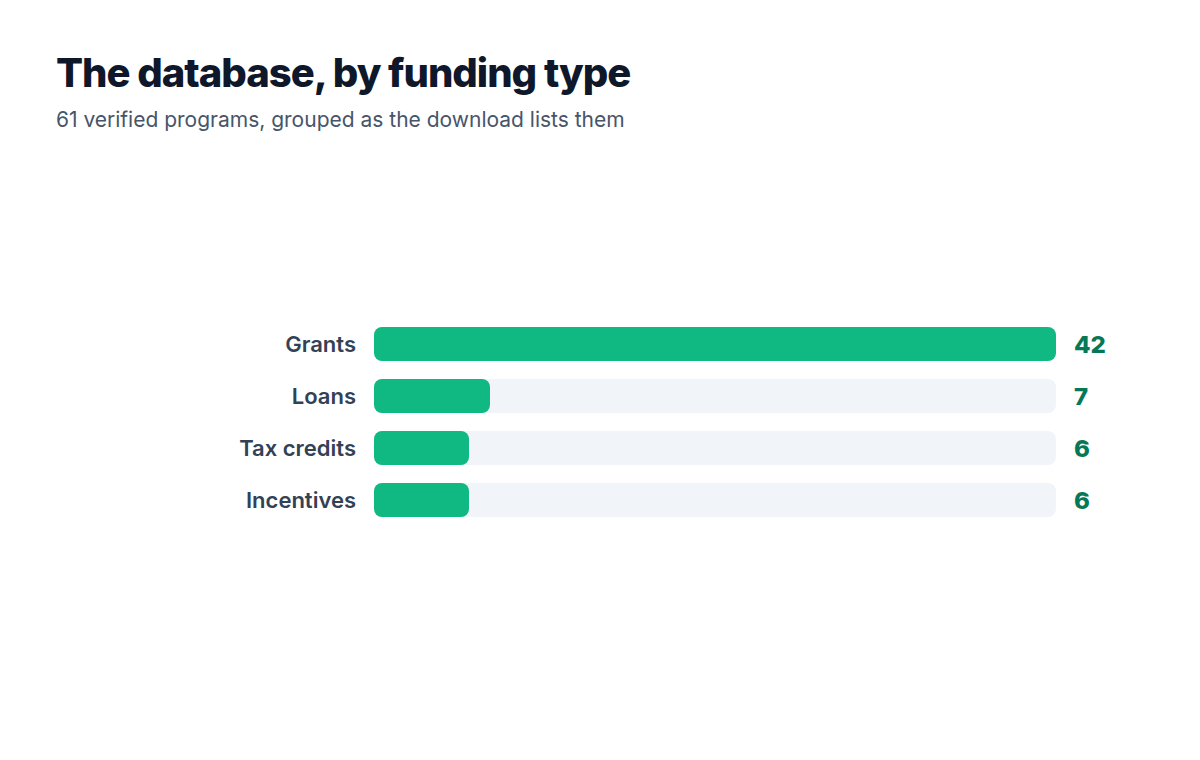
If the searching and verifying is the part you would rather not do, The Real Estate Grant Stack is a $49 downloadable toolkit that does that work for you: a step-by-step playbook, a database of real funding programs with verified links, a bank of application templates, and an annotated swipe file of strong application writing.