Historic Rehabilitation Tax Credit
GrantEstate · 7 min read
By Donato Stough, founder of GrantEstate in Flower Mound, Texas. Every program cited here links to its official source page — each was checked against the agency’s own site before it went in. More about why I built this →
The federal historic rehab credit covers 20% of qualified renovation spending. Who qualifies, the three-part certification, and how state credits stack.
Short answer: The federal historic rehabilitation tax credit is worth 20 percent of qualified rehabilitation spending on a certified historic structure that produces income. You cannot claim it on a building you live in, you cannot retrofit historic significance onto a building, and more than 30 states add their own credit.
Of every incentive available to a real estate owner in the United States, this is the one that does the most work — and the one most often discovered too late to use.
The federal historic rehabilitation tax credit is worth 20% of qualified rehabilitation expenditures on a certified historic structure. It is not a grant, and it does not arrive as a cheque. It arrives as a dollar-for-dollar offset against federal tax, and because of how it is structured, it can often be converted into cash through an investor.
That combination — large, real, and convertible — is why adaptive reuse of old buildings is the single most reliably funded category of real estate project in the country. It is also why the question "is this building historic?" belongs in your due diligence, not in your construction schedule.
What qualifies for the 20% historic tax credit?
Two conditions decide whether a building qualifies, and both are pass-or-fail: the building must be a certified historic structure, and it must produce income. Neither can be fixed after the fact.
The building must be a certified historic structure
Either it is individually listed on the National Register of Historic Places, or it is a contributing building within a registered historic district and certified as such by the National Park Service. A local landmark designation alone does not do it. An old building does not do it.
You cannot retrofit significance onto a building. If the structure is not already designated or contributing, the credit is not available to you, and no amount of careful restoration changes that.
The rehabilitation must be "substantial"
Under IRS rules, the rehabilitation must be substantial — a test expressed relative to the building's adjusted basis rather than as a flat dollar figure. This is a calculation, not a vibe, and it is one of the reasons a tax advisor belongs in the project before construction starts rather than in April.
And it must be income-producing
This is the condition that surprises people. The credit applies to a building that produces income — commercial property, or residential property held as a rental. A building you occupy personally as your home does not qualify, even if it is a certified historic structure and even if the work is substantial.
For most readers that is not a limitation but a strategy: the credit is the strongest reason to hold and rent a historic building rather than sell it.
What is the three-part certification?
The credit is administered jointly by the National Park Service and your State Historic Preservation Office, through a three-part certification:
- Part 1 — evaluation of significance. Establishes that the building is a certified historic structure.
- Part 2 — description of the rehabilitation. Describes the planned work and is reviewed for conformance with the Secretary of the Interior's Standards for Rehabilitation.
- Part 3 — request for certification of completed work. Confirms, after the work is finished, that what was built matches what was approved and meets the standards.
The practical consequence of this sequence: your design decisions are reviewed before you build them. Part 2 is where projects get into trouble, because work that is already completed and does not meet the standards cannot simply be undone. This is why the certification path belongs in your pre-construction timeline, not your post-construction paperwork.
One more thing worth knowing: the credit for non-historic buildings constructed before 1936 is 10%, and its availability has been subject to legislative change. Confirm the rules in effect for your project year rather than relying on a summary — including this one.
Can you stack a state credit on top?
The federal credit is the headline, but in many projects the state credit is the difference between a deal that pencils and one that does not.
More than 30 states operate some form of historic rehabilitation tax credit. Structure varies widely: some are capped and allocated competitively, others are entitlement-style, and the credit rates and carry-forward rules differ from state to state. State credits are frequently more usable than the federal one on smaller projects, which makes them especially relevant to owners working on a single building rather than a portfolio.
They are often stackable with the federal credit on the same rehabilitation. That stacking is not automatic, though — the state program may have its own certification requirements, its own deadlines, and its own annual cap that can close mid-year. Find out whether your state's program is currently funded before you model it.
Start with the National Park Service's tax incentives pages and then go to your State Historic Preservation Office directly. Your SHPO is also the entity that reviews the federal certification, so the same office holds both answers.
How does the credit become cash?
A tax credit is only useful if you have tax liability to offset. Developers frequently do not, in the year they need it, at the scale the project generates.
That is why credits are commonly syndicated — sold to investors for cash at a discount per credit dollar. The investor gets the credit; you get money for construction. A first-year project with limited tax capacity is exactly the profile that syndicates.
Two consequences follow. First, model the credit at its market value, not at face value, when you underwrite. Second, treat the discount as a cost of capital rather than a loss — you are exchanging some of the credit's value for the liquidity a construction budget actually requires.
Where this leaves you
- If you are looking at a building from before the mid-20th century and it is designated or in a historic district, price the credit before you close. It can change what the property is worth to you.
- Check the state program in the same week. A stacked state credit occasionally exceeds the federal one in practical value.
- Bring in a tax advisor who has syndicated credits before. The interaction between the credit, depreciation, and the certification process is not do-it-yourself territory.
- Sequence Part 2 before construction. The standards review is a design review, and design reviews happen before the work, not after.
- If you planned to sell it, model the hold-and-rent case with the credit against the flip case. Sometimes holding nets more, and the answer often surprises owners.
If you are evaluating a specific property, the property-level questions to ask before you buy are the right starting point, and grants for real estate investors covers how this credit sits alongside the other instruments people call grants. If you are converting a commercial building, the commercial guide puts the credit in context with infrastructure and energy money.
Before you accept any incentive, understand what can claw the money back. Historic credits carry their own version of that risk: certify first, build second, or you may find the credit was never yours.
Where to check this yourself
The primary sources behind this article are listed below. Program terms change, so confirm the current cycle and eligibility at the source before you rely on anything here. Program terms change, so confirm the current cycle and eligibility at the source before you rely on anything here.
- Historic preservation tax incentives — National Park Service
- IRS Form 3468, Investment Credit — Internal Revenue Service
Both are maintained by the agency that runs the program, not by us.
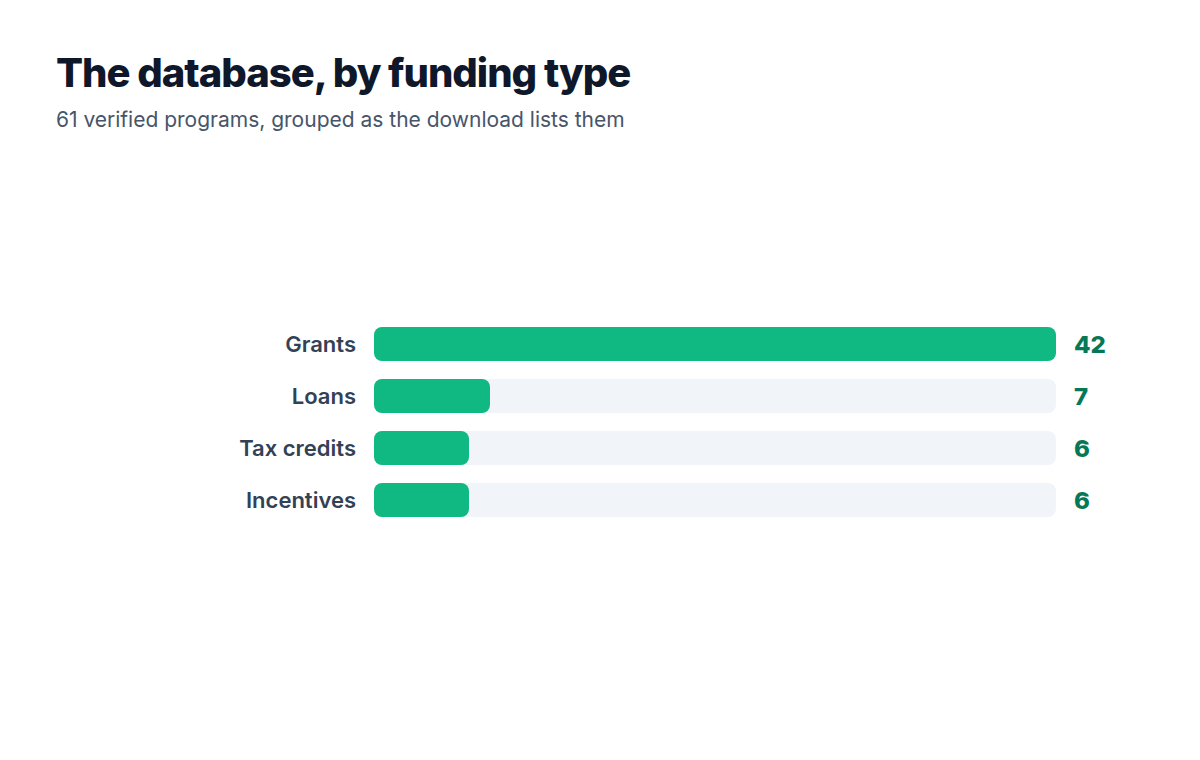
The Real Estate Grant Stack is a $49 downloadable toolkit with the database of real programs and verified official links, the application templates, and the timelines — so you can check whether a building qualifies before you commit to it.