C-PACE Financing for Commercial Property
GrantEstate · 5 min read
By Donato Stough, founder of GrantEstate in Flower Mound, Texas. Every program cited here links to its official source page — each was checked against the agency’s own site before it went in. More about why I built this →
C-PACE is long-term, fixed-rate, non-recourse financing for efficiency, water, and resilience work on commercial property. Here is how it works, what it costs.
Short answer: C-PACE is long-term, fixed-rate, non-recourse financing for energy, water, and sometimes resilience improvements on commercial property, repaid through a property tax assessment and passed to the next owner if you sell. It is not a grant. It is non-dilutive capital that is often left on the table because owners never ask.
Commercial Property Assessed Clean Energy — C-PACE — is the most under-used piece of non-dilutive money in commercial real estate, and it confuses people for one reason: it looks like a grant and behaves like a loan.
It is a loan. Specifically, it is a voluntary assessment you agree to add to your property tax bill, which repays the money borrowed to improve the building. Because it is repaid through the tax roll rather than through a mortgage, it has features no bank loan offers.
How does C-PACE work?
A local C-PACE program lends against your property and places an assessment on it. You repay that assessment over a long term at a fixed rate, alongside your property taxes, and the obligation stays with the property if you sell it.
Three features matter more than the rate.
It is generally non-recourse to the owner. The assessment is secured by the property, not by a personal guarantee, which is why it attracts owners who do not want to sign for more debt.
It transfers with the building. A buyer inherits the remaining payments, which spreads the cost of an improvement across whoever owns the building while it is paying for itself.
It does not consume your equity. You are not selling a stake to fund a roof, a chiller, or a lighting retrofit.
What can C-PACE pay for?
The eligible work is set by the state or local program, and the categories are consistent across most of them: energy efficiency, renewable energy, water conservation, and in some programs resilience improvements such as storm hardening or flood mitigation.
The database entry we maintain lists typical project sizes from the low hundreds of thousands of dollars to tens of millions, which tells you something important — this tool is built for institutional and mid-sized commercial assets, and it is not designed for a single-family rental.
Eligibility is also place-based. You can only use C-PACE where your jurisdiction has enabled it and a program administrator operates. That is the first thing to verify, before you spend time on anything else.
Is C-PACE financing available on your property?
Check three things in order.
- Does your state or locality have an active C-PACE program? The national program directory at PACE Nation is the fastest way to find out, and it tells you which administrator runs it.
- What incentives already exist for the work you are planning? DSIRE lists federal, state, utility, and local incentives by ZIP code, so you can see the rebates that reduce the project's cost before you finance the remainder.
- Will your existing lender consent? C-PACE is a new lien on the property, and mortgage documents commonly require the lender's agreement. Ask early, in writing, and expect the administrator to have done this before.
How does C-PACE stack with grants and rebates?
In this order, generally.
First, take the free money. Utility rebates for efficiency measures are non-competitive and pay for work you were likely doing anyway. One caution from our own database: most rebate programs require pre-approval before equipment is purchased or installed, so file the paperwork before you sign a contractor's proposal, not after.
Then finance the rest with C-PACE rather than pulling cash out of the deal or taking a personal guarantee. Because the term is long and the rate is fixed, the annual assessment can be smaller than the energy savings on a well-scoped project.
Then look at tax credits where the building qualifies — the federal historic rehabilitation credit is the largest one for commercial real estate, and it applies to the building rather than the land.
What are the honest downsides?
C-PACE is debt secured by a lien, and it is not a small commitment on a property you might sell quickly.
- It is not free money, and it is not a grant. You repay it, with interest, on your tax bill.
- It can complicate a refinancing or a sale if a new lender is unfamiliar with the structure, so disclose it early rather than at closing.
- It has transaction costs — underwriting, legal work, and an assessment that must be recorded.
- Availability is uneven. Some states have strong programs, some have none, and eligibility categories differ.
None of that makes it a bad tool. It makes it a tool that rewards doing the homework before you need it.
The short version
C-PACE is long-term, fixed-rate, non-recourse financing repaid through a property tax assessment that stays with the building. It is not a grant, and we would rather say so plainly than let you discover it mid-application. Where it exists and your lender consents, it is one of the few ways to improve a commercial asset without diluting ownership or pledging personal assets — and it stacks cleanly with rebates and tax credits. Check the commercial asset guide for how it fits alongside everything else available to a commercial project.
Where to check this yourself
The primary sources behind this article are listed below. Program terms change, so confirm the current cycle and eligibility at the source before you rely on anything here.
- PACE Nation — C-PACE program directory — the national resource for commercial PACE programs and administrators
- DSIRE — Database of State Incentives for Renewables and Efficiency — North Carolina State University, funded by the U.S. Department of Energy
Both are maintained by the organizations that run the programs, not by us.
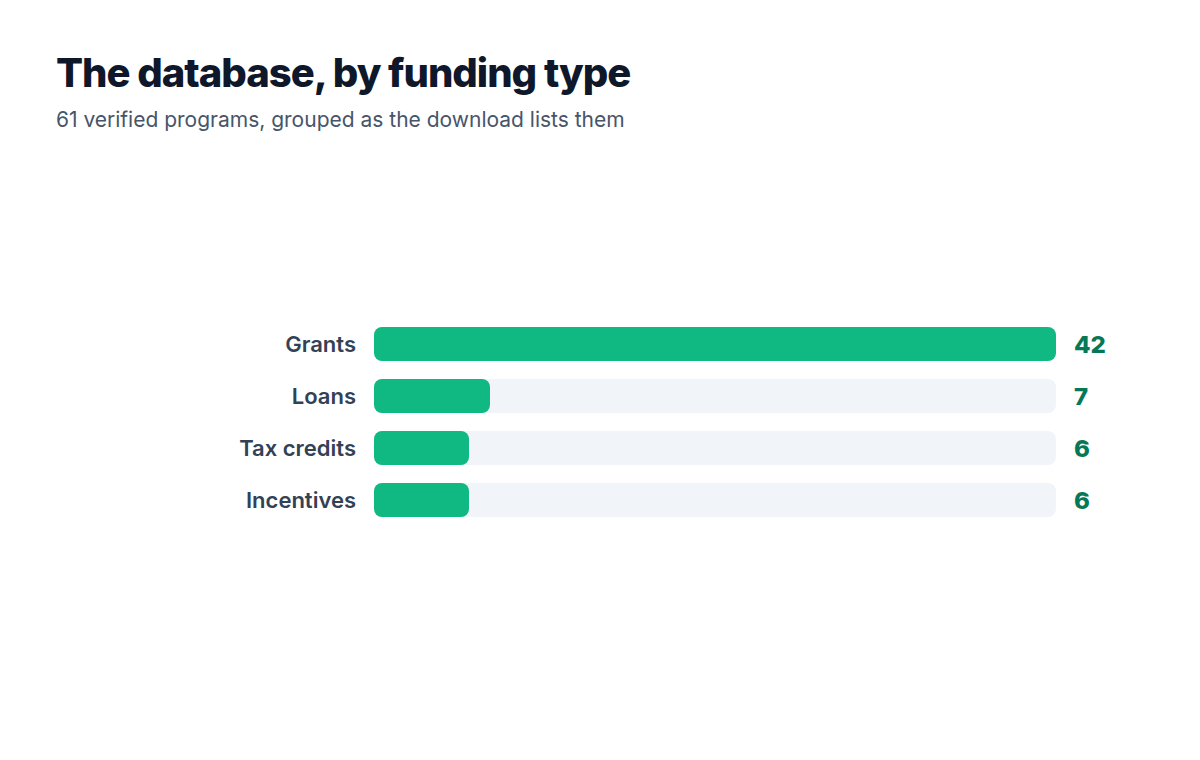
The Real Estate Grant Stack is a $49 downloadable toolkit that covers C-PACE alongside 61 grant, credit, and incentive programs, with an official source link on every entry — so you can see what your jurisdiction actually offers instead of guessing.