Commercial Real Estate Grants: What Exists
GrantEstate · 7 min read
By Donato Stough, founder of GrantEstate in Flower Mound, Texas. Every program cited here links to its official source page — each was checked against the agency’s own site before it went in. More about why I built this →
Hotels, warehouses, restaurants, and retail projects rarely win literal grants. Here is where the real non-dilutive money sits for each commercial asset type.
Short answer: Few programs hand out cash to a commercial project simply because it is commercial. The money that exists attaches to something specific: a historic building, a contaminated site, public infrastructure the project needs, its energy performance, or a low-income census tract.
If you are developing a hotel, a warehouse, a restaurant building, or a retail center, you will find very few programs that hand out cash for a commercial project simply because it is commercial.
What you will find, if you look properly, is a substantial amount of non-dilutive money organized around what the project does rather than what it is. Jobs. Contamination cleaned up. A historic building preserved. Energy saved. Public infrastructure that unlocks a site.
This guide walks through each commercial asset type and tells you honestly where the money is — including the many cases where it is a tax credit or a negotiated local incentive rather than a grant.
Why do commercial projects rarely win grants?
Commercial projects usually qualify for money through one of five mechanisms:
Tax credits. Offset against taxes owed, often syndicated to investors for cash. The federal historic rehabilitation credit is the dominant one for commercial real estate, and many states run their own version.
Local incentives. Tax increment financing, tax abatement, payments in lieu of taxes, fee waivers. Negotiated with the locality, not competitively applied for.
Public infrastructure funding. A government agency funds the roads, water, sewer, or rail spur that makes your private project possible. You are the beneficiary of a public project.
Utility rebates. Non-competitive, applies to building systems you were replacing anyway.
True grants. Genuinely competitive, usually tied to a specific public benefit, and frequently restricted to governments and nonprofits — meaning you participate as a partner rather than as the applicant.
Knowing which of these five you are actually chasing saves a lot of wasted effort.
Do hotels and resorts qualify for grants?
Historic tax credits are the single most important source here. A large share of American hotel adaptive-reuse projects — downtown conversions of warehouses, office buildings, and factories — use the federal historic rehabilitation credit, often stacked with a state credit.
The requirements matter: the building must be certified historic, the rehabilitation must be substantial under the rules, and the credit applies to the building rather than the land. The certification process runs through the National Park Service and your state historic preservation office, and it takes time. Plan for it before construction, not after.
New Markets Tax Credits can apply to hotel projects in low-income communities, though the transaction costs mean this structure generally suits larger deals.
State tourism and destination development programs exist in some states. Availability varies considerably, and many are competitive and politically influenced.
Local TIF, abatement, and convention or tourism-related incentives are frequently the difference between a hotel project penciling or not. These are negotiated, and they start well before you close on the land.
Utility rebates apply to HVAC, lighting, laundry, and commercial kitchen equipment, and are often larger per item than people expect.
What funding exists for warehouses and industrial property?
Economic development infrastructure funding. Programs at the federal and state level fund public infrastructure — road improvements, water and sewer extensions, rail spurs — that supports private industrial development and job creation. The application is typically made by the local government with your project as the driver.
This is one of the most realistic paths for an industrial developer, because the public agency gets the credit for the jobs and the tax base, and you get the infrastructure.
Local TIF and abatement are the standard tools for industrial recruitment. Expect to negotiate, and expect to be asked about job numbers and wages.
State job-creation and capital-investment incentives are often credit- or rebate-based and tied to payroll and employment targets. These are usually administered by the state economic development agency.
Brownfield programs matter enormously here. Former industrial sites frequently have contamination, and cleanup funding is genuinely available — assessment grants, cleanup grants, and revolving loan funds that lend directly to owners and developers.
Port authority and foreign-trade-zone programs may offer additional tools depending on your location.
What funding exists for restaurant real estate?
At the real-estate level, grants are scarce. At the building level, three things matter.
Historic tax credits. Downtown restaurant projects are frequently adaptive reuse of historic buildings, which makes the federal and state historic credits directly relevant. This is the most consequential item on this list.
Utility rebates on commercial kitchen equipment. Commercial refrigeration, cooking equipment, ventilation, and dishwashing rebates are often the largest per-item incentives available to any small commercial building owner, and they are non-competitive.
Local facade and downtown revitalization programs, frequently funded through business improvement districts or federal block-grant pass-through. Awards are usually modest and may carry requirements about signage, hours, or appearance.
Be skeptical of "restaurant grants" advertised online. Many are small, narrowly targeted, tied to specific community benefits such as food access in underserved areas, and often require a nonprofit partner. A few are legitimate; most are marketing.
What funding exists for malls and retail?
Distressed retail redevelopment is genuinely fundable, largely because a dead shopping center is a political problem as well as a commercial one.
The primary tool is local TIF, abatement, and redevelopment authority programs. Local governments often want these projects to happen and have real tools to help.
Brownfield programs are frequently relevant. Former auto-oriented retail — gas stations, auto repair, dry cleaners — carries a well-understood contamination profile, and that makes it fundable.
New Markets Tax Credits apply to real estate in low-income communities, including retail redevelopment, though the structure generally suits larger projects.
Historic credits apply to pre-1960s downtown retail buildings.
Economic development and community facilities funding may be available where a project restores jobs and services to an underserved area.
Where a project includes a genuine community facility component — a health clinic, childcare, a grocery in a food desert — additional community development funding may come into play, often through a nonprofit partner.
What about office and coworking?
The thinnest category for non-dilutive money. What is available: utility rebates, historic credits for adaptive reuse of older buildings, local incentives tied to job creation or downtown revitalization, and C-PACE financing for efficiency and resilience improvements.
C-PACE deserves a mention throughout this article: it is long-term, fixed-rate, non-recourse financing repaid through a property tax assessment, and it stays with the property if you sell. It is not a grant, but it is non-dilutive, and it is frequently stackable with rebates and credits.
What is the one thing that decides whether you win?
For almost every commercial asset type, the deciding factor is the quality of your local government relationship, not the quality of your application prose.
Infrastructure funding, TIF, abatement, and redevelopment authority support all require a public body to act on your behalf. That means a hearing, often a council vote, and a credible story about jobs, tax base, and community benefit.
Which means the most valuable thing you can do is schedule a fifteen-minute meeting with your city's economic development director before you need anything, and ask what their current priorities are and what tools they have.
Our step-by-step application guide covers how to build the case itself, and how real estate grants work explains who controls each funding source. If your project is in a rural area, also read the state and local guide — rural commercial projects have a distinct set of programs through USDA Rural Development that most developers never check.
The short version
Commercial projects rarely win literal grants for being commercial. They win money by producing a public benefit — historic preservation, cleanup, jobs, energy savings, infrastructure leverage — and by having a local government willing to act on their behalf.
The two highest-value moves for most commercial developers are: check the historic credit question on every older building, and build the economic development relationship long before you need it.
Where to check this yourself
The primary sources behind this article are listed below. Program terms change, so confirm the current cycle and eligibility at the source before you rely on anything here. Program terms change, so confirm the current cycle and eligibility at the source before you rely on anything here.
- ENERGY STAR for buildings — U.S. Environmental Protection Agency
- SBA 504 loan program — U.S. Small Business Administration
Both are maintained by the agency that runs the program, not by us.
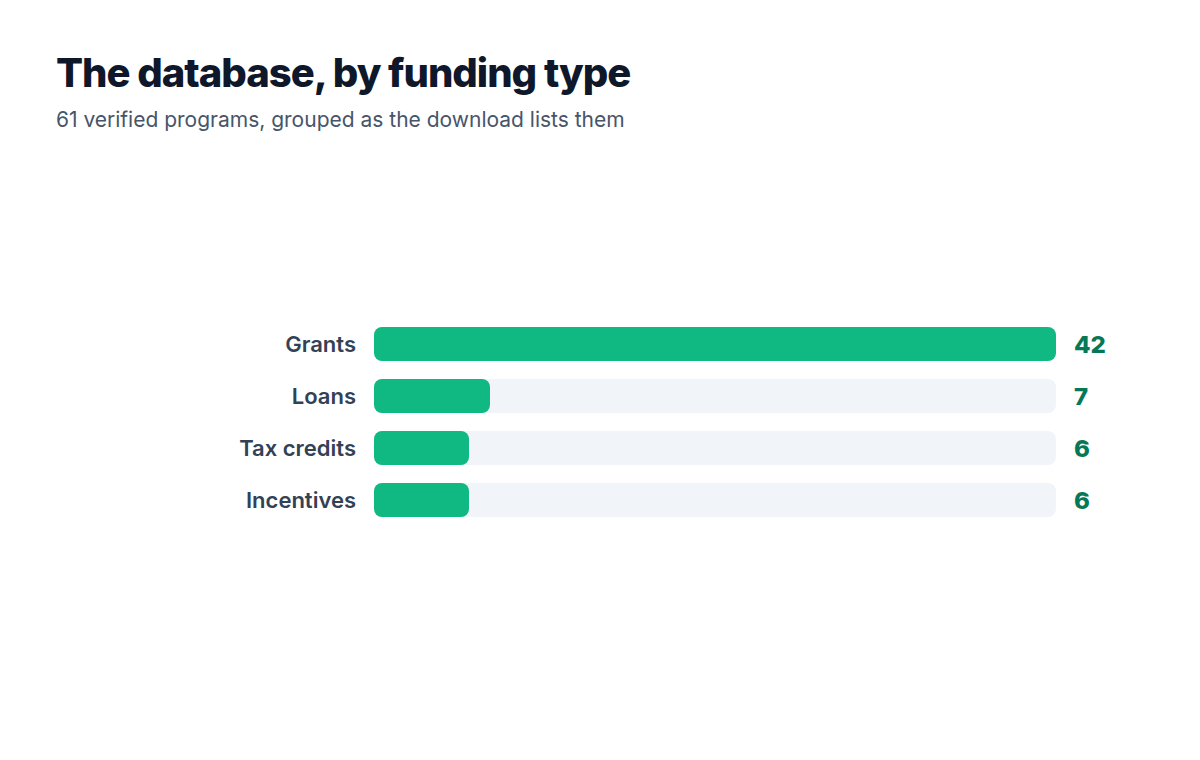
The Real Estate Grant Stack is a $49 downloadable toolkit that maps these programs by asset type and benefit, with a database of real programs and verified links — so you can see what applies to your project instead of guessing.