State and Local Real Estate Grants
GrantEstate · 8 min read
By Donato Stough, founder of GrantEstate in Flower Mound, Texas. Every program cited here links to its official source page — each was checked against the agency’s own site before it went in. More about why I built this →
State and local programs are where most small developers actually win grant money. Here is how they differ from federal grants, and how to find yours.
Short answer: For a small or early-stage real estate business, state and local programs are usually where the money actually is. Every state runs its own housing finance agency, historic preservation office, economic development agency, and energy office, and most publish funding rounds you can apply to.
Most articles about real estate grants are written as though Washington is where the money lives.
In practice, for a small or early-stage real estate business, state and local programs are usually where you actually win. Not because the awards are bigger — they often are not — but because they are smaller, more local, more accessible, and more likely to be run by people who will take your phone call.
The guide below explains how state and local funding differs from federal funding, what each agency controls, and how to find the programs in your own state.
How do state and local programs differ from federal?
Federal programs are national, formula-driven or competitively awarded, and governed by detailed uniform rules. They are announced on grants.gov. Registration takes weeks. Many of the largest federal real estate programs are not awarded to developers at all — they are allocated by formula to states and cities, which then re-grant or lend the money locally.
State programs are shaped by state priorities, funded by a mix of state revenue, bond authority, and federal pass-through, and administered by state agencies. Eligibility and terms differ substantially from one state to the next.
Local programs are the smallest and most discretionary. A city or county with a housing trust fund, a redevelopment authority, or a land bank may have money and a great deal of latitude in how it is awarded.
Three consequences that matter:
There is no national directory of state and local programs. This is why generic grant searches fail. You have to look state by state.
Relationships matter more at the local level. A program officer who knows your name and has seen your project is a real advantage, and it is available to anyone willing to make a phone call.
Terms vary enormously. What is a grant in one state is a forgivable loan in another and simply unavailable in a third. Never assume a program in another state exists in yours.
Which state agencies matter most?
Your state housing finance agency
The state housing finance agency is typically the single most important funding relationship available to a housing developer, and it is the agency most people have never heard of.
What housing finance agencies do:
- Allocate the low-income housing tax credit. This is the main source of equity for affordable rental housing in the United States, allocated through a competitive annual round governed by the agency's Qualified Allocation Plan. For-profit developers are major participants.
- Issue tax-exempt bonds for multifamily and sometimes single-family development, often paired with tax credits. In many states, bond financing is what makes 4% credit deals work.
- Run gap financing and soft-second loan programs, which fill the difference between what a project costs and what conventional debt and equity will support.
- Administer HOME funds and state housing trust fund dollars.
Even if you are not applying this year, read the current Qualified Allocation Plan. It is the clearest statement of what your state actually wants built, and it will tell you whether your project type is competitive.
Your state historic preservation office
State historic preservation offices administer the federal historic credit certification process — the three-part application that determines whether your building qualifies and whether your rehabilitation meets the standard.
Many states also operate a state historic tax credit of their own. State credits are frequently smaller but more usable than the federal credit, and on some projects they are the deciding factor. Availability varies widely, so check your own state rather than assuming.
State offices also administer preservation planning grants and coordinate National Register nominations. Getting a building listed — or confirming it is within a certified historic district — can change what your project is worth.
Your state economic development agency
Where the tools are aimed at jobs, tax base, and physical redevelopment:
- Brownfield and voluntary cleanup programs, including grants and revolving loan funds
- Redevelopment and enterprise zone incentives
- Job creation and capital investment credits or rebates, usually tied to payroll and employment targets
- Infrastructure and site development funds
- Sometimes direct loan programs for real estate projects that create employment
Economic development programs are usually negotiated or scored on job and investment metrics rather than on narrative quality.
Your state energy office
State energy offices administer a mix of federally funded and state-funded programs:
- Energy efficiency programs for commercial and multifamily buildings
- Low-interest energy loan funds
- Weatherization and retrofit programs
- Renewable energy incentives, sometimes in coordination with utility programs
Many of these reach buildings through utilities or local governments, so ask the office how projects in your area are actually funded.
Local government: where the discretionary money is
Three places to look.
Community development department. If your city or county receives federal block grant or HOME allocations, it re-grants or lends those dollars locally. Ask what is currently open and — this is the important part — ask to be put on the notification list for future solicitations. That single request is the highest-value fifteen minutes in this entire article.
Economic development department. Ask what their current priorities are and what tools they have: tax increment financing, tax abatement, payments in lieu of taxes, fee waivers, infrastructure assistance. Priorities change with administrations, so ask this year rather than relying on what you heard two years ago.
Redevelopment authority or land bank. These entities often hold property, can sell below market, and sometimes fund demolition or site preparation. If you are working in a distressed area, they may be your most motivated partner.
How do you find your state's programs?
A repeatable sequence, roughly three hours of work:
- Find your state housing finance agency through ncsha.org. Read the current Qualified Allocation Plan and list every program on the agency's funding page.
- Find your state historic preservation office and check whether your state offers a state historic tax credit, plus what preservation grants exist.
- Find your state economic development agency and read its incentives and brownfield pages.
- Find your state energy office and list commercial and multifamily programs.
- Call your city or county community development department and ask what is open and how to get on the notification list.
- Check DSIRE (dsireusa.org) for utility and state incentives by ZIP code.
- Check grants.gov for federal programs, and set up saved search alerts.
Then filter ruthlessly. A list of forty programs is useless; a list of four you actually qualify for is a plan.
Which eligibility question decides everything?
Before you invest time in any of these, confirm you are an eligible applicant. Many state and local programs are restricted to nonprofits, units of government, or specific entity types.
If you are a for-profit and you are not on the eligible list, your route is a partnership — a municipal co-applicant, a nonprofit joint venture, or a fiscal sponsor. Decide this before you write anything, because it changes the budget, the work plan, and the narrative. Our main guide covers those structures in detail.
If you are working in a rural area, add one more step: check USDA Rural Development. Its programs cover rural business lending, community facilities, energy projects, and multifamily housing, and they are routinely overlooked by developers who assume federal money is not for them.
For asset-specific guidance, see commercial real estate incentives, and if you are weighing how much of what you find is genuinely free money, read whether grants have to be repaid before you build a capital stack around one.
The short version
State and local programs are less glamorous than federal grants and far more winnable for a small operator. Four state agencies — housing finance, historic preservation, economic development, and energy — plus your city's community development department will cover the large majority of what is available to you.
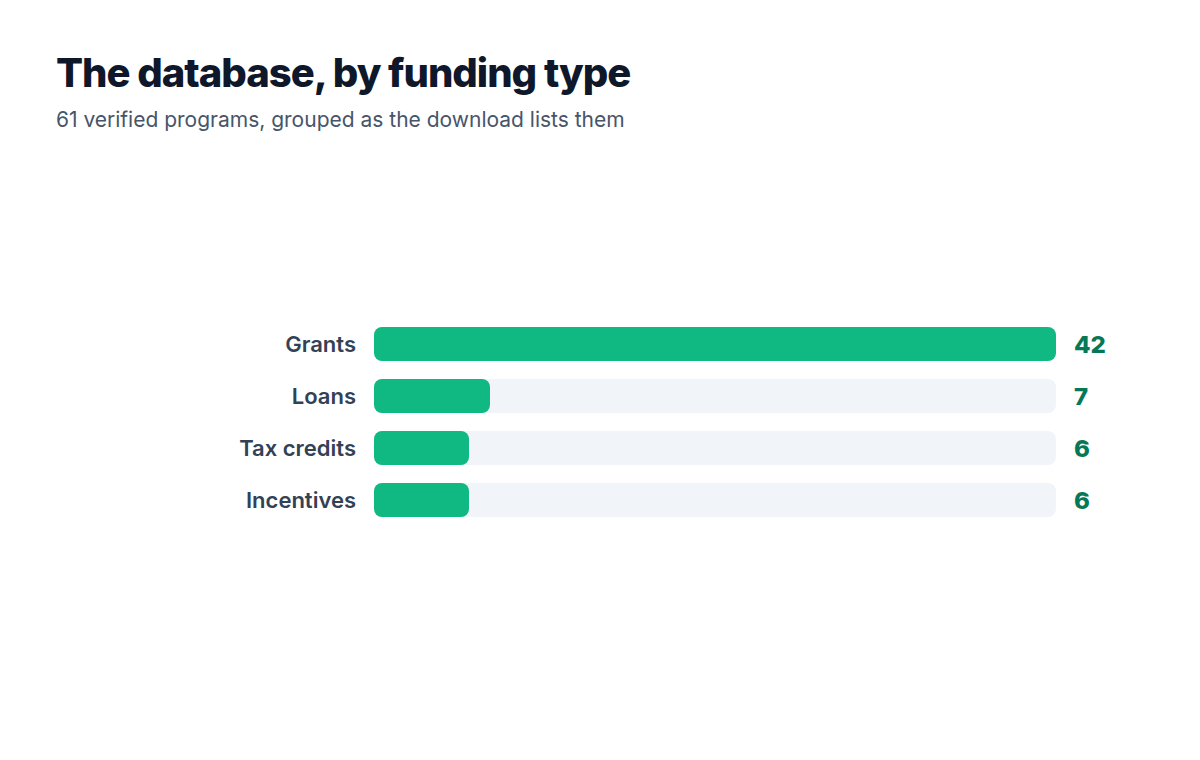
The obstacle is that none of it is in one place. Finding and verifying it, state by state, is the
Where to check this yourself
The primary sources behind this article are listed below. Program terms change, so confirm the current cycle and eligibility at the source before you rely on anything here.
- Office of State and Community Energy Programs — U.S. Department of Energy
- Historic preservation tax incentives — National Park Service
Both are maintained by the agency that runs the program, not by us.
tedious part. The Real Estate Grant Stack is a $49 downloadable toolkit that does that work: a step-by-step playbook, a database of real programs with verified links, application templates, and an annotated swipe file — so you can spend your time on the application rather than the search.