Brownfields Cleanup Funding: How to Get It
GrantEstate · 6 min read
By Donato Stough, founder of GrantEstate in Flower Mound, Texas. Every program cited here links to its official source page — each was checked against the agency’s own site before it went in. More about why I built this →
Contamination history can be a funding asset. How EPA assessment and cleanup grants work, and why regional revolving loan funds are the route for developers.
Short answer: Brownfields funding pays for environmental assessment and cleanup of land with a real or suspected contamination history. It does not pay you to buy the land. Grants go to public and nonprofit applicants, so a for-profit developer usually reaches them through a regional revolving loan fund.
A contaminated site is priced as a liability. Sometimes it is an asset — because the cleanup is exactly the kind of public benefit these programs exist to buy.
The Environmental Protection Agency's brownfields programs fund the assessment and remediation of land that is complicated by real or perceived contamination. For a developer, three things matter more than the program names: which of the three funding types you can actually access, when in the deal to start, and who signs the application.
When should you start the brownfields process?
This is the single most valuable piece of advice on this page. Nearly everything else is a variation on it.
A Phase I environmental site assessment is a records and site review. A Phase II is the one with sampling — and it is the one that costs real money, because drilling, lab work, and a consultant's time are not cheap. That cost is why buyers skip it, accept an indemnity, and discover the problem eighteen months later.
There is grant money specifically for that cost. And the value is not only budgetary: an assessment funded before closing changes your negotiating position. You approach the seller with a documented condition rather than an anxiety, and price, escrow structure, and remediation responsibility all become negotiable facts instead of hypotheticals.
That is worth more than the grant.
Which EPA brownfields funds can a developer apply for?
The programs are structurally different, and the difference decides whether you can apply directly or must work through a partner.
- Assessment grants fund Phase I and Phase II environmental site assessment, planning, and community engagement. Historically in the range of $100,000 to $500,000 per award. Eligible applicants have included states, local governments, Tribes, regional councils, and certain nonprofits. A for-profit developer is generally not an eligible applicant.
- Cleanup grants fund the actual remediation of a brownfield site, historically up to $500,000 per award. They require a Phase II assessment and often a state-approved remediation plan, and usually carry a 20% cost share that can sometimes be met with in-kind services. The eligibility structure is the same as assessment grants.
- Revolving loan funds. EPA capitalizes regional RLFs, which then make loans and subgrants to site owners and developers — including for-profit entities. This is the most accessible brownfield route for a for-profit developer.
Read that third bullet again, because it is the practical answer to "can I get this money?" For the assessment and cleanup grants, you are typically the beneficiary of a public or nonprofit applicant rather than the applicant. For a regional RLF, you borrow — the money is lent to you on terms negotiated for your project.
So the two moves are different in kind:
- Find out who in your region holds brownfield grants. That entity — usually a city, county, or regional council — is your partner, and the project becomes part of their application.
- Find out which regional RLF covers your area and what it lends on. EPA's brownfields program pages are the starting point for locating the RLF grantees in your region.
Both conversations should happen before you waive an environmental contingency, not after.
Do states run their own brownfields programs?
Federal brownfields money is not the only pot. Many states operate their own voluntary cleanup programs and their own brownfield or remediation funds, and the state layer is frequently easier to access than the federal one — smaller awards, shorter cycles, and an agency whose staff you can actually reach.
State programs also vary enormously in structure: some are grants, some are loans, some are tax incentives or liability protections rather than cash, and the rules differ by jurisdiction. Rather than guess, contact your state environmental agency and ask two questions: what funding do you administer for assessment and remediation, and what does the voluntary cleanup process look like for a private owner?
Treat any summary — including this one — as a starting point to verify, not as a substitute for the agency's own current guidance.
What this money is not
- It is not a payment for buying contaminated land. Nothing here rewards you for acquiring a cleanup problem. The programs fund assessment and remediation of sites with a redevelopment use.
- It is rarely paid to a for-profit applicant directly in the grant categories. If someone tells you otherwise, ask which entity signs the application.
- It does not eliminate the contamination risk from your deal. It reduces the cost and improves your information. Your lender will still care about liability, and your counsel will still need to structure it.
- The clean-up standard is a state decision. What "remediated" means for your site is set by the state program that oversees it, which is one more reason the state conversation comes first.
The short version
Contamination history is a due diligence finding, and it is also an eligibility trigger. Get a Phase I, then get funding for the Phase II before you close, because a documented condition is negotiating leverage and a grant-funded one costs you nothing. For the assessment and cleanup grants, your route is a partnership with the local or regional entity that holds them. For direct money as a for-profit developer, the regional revolving loan fund is the door that opens. And check your state's voluntary cleanup program in the same week you check EPA's, because the state is often the faster path.
If you are looking at a single-family property with a contamination history, grants for house flipping walks through how this works on a smaller deal. For a larger or industrial site, the commercial guide covers how cleanup money sits alongside infrastructure and energy incentives. And if you are assembling the application itself, the step-by-step guide covers the process end to end.
Where to check this yourself
The primary sources behind this article are listed below. Program terms change, so confirm the current cycle and eligibility at the source before you rely on anything here. Program terms change, so confirm the current cycle and eligibility at the source before you rely on anything here.
- EPA brownfields program — U.S. Environmental Protection Agency
- EPA brownfields grant types — U.S. Environmental Protection Agency
Both are maintained by the agency that runs the program, not by us.
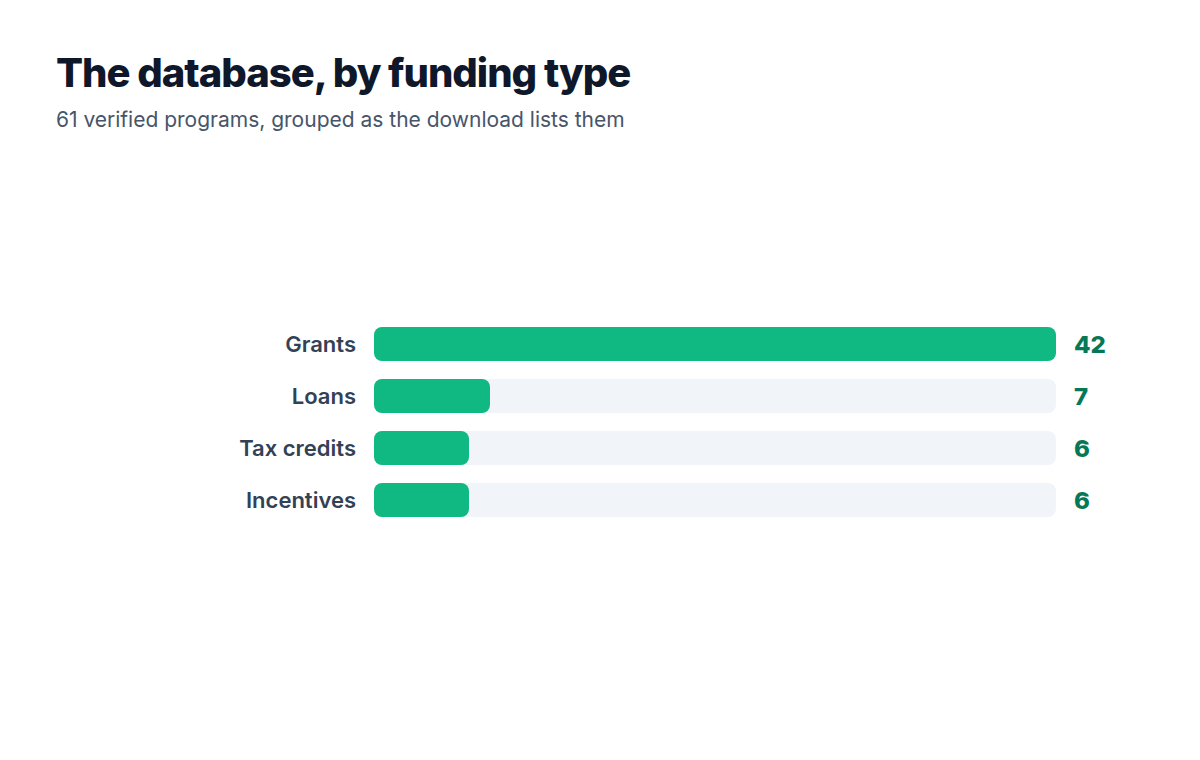
The Real Estate Grant Stack is a $49 downloadable toolkit containing the program database with verified official links, the application templates, and the timelines — so you can work out what your site qualifies for before you spend money on a consultant.