Grants to Buy Real Estate: What Is Real
GrantEstate · 5 min read
By Donato Stough, founder of GrantEstate in Flower Mound, Texas. Every program cited here links to its official source page — each was checked against the agency’s own site before it went in. More about why I built this →
Most so-called grants to buy property are not grants. Here is which real programs can fund a real estate acquisition, and who can apply for that money.
Short answer: Real grants almost never pay to buy an investment property outright. Federal acquisition money flows to governments and nonprofits, or through below-market loans, not as cash to an investor. What does exist: soft-second and gap loans for affordable housing, owner-occupant help in rural areas, Section 108 loan guarantees, and tax credits that cut a deal's cost.
If you searched for a grant to buy a house, a duplex, or a commercial building, the honest answer starts with what grants are for.
A grant is public money spent to produce a public outcome. Buying an asset so that one owner's balance sheet improves is not a public outcome, which is why you will not find a federal program that writes a check to an investor for a down payment.
That does not mean acquisition money is absent. It means the money travels through specific channels, most of which are open to a government or a nonprofit rather than to you directly.
Why are grants to buy real estate so rare?
Because the rules that govern public money rarely allow it to buy property for private benefit.
Federal grant programs generally restrict who may apply — units of government, tribes, and nonprofit organizations — and restrict what the funds may purchase. When acquisition is allowed, it is allowed for a purpose: creating affordable housing, stabilizing a neighborhood, redeveloping a contaminated site, or supporting a public facility.
So the practical question is not "is there a grant to buy property". It is "which public purpose could my deal serve, and which program funds that purpose".
If none of your project serves one of those purposes, the honest answer is that debt and equity fund your purchase, and grants may reduce your costs afterwards.
Which real programs can actually help you acquire a property?
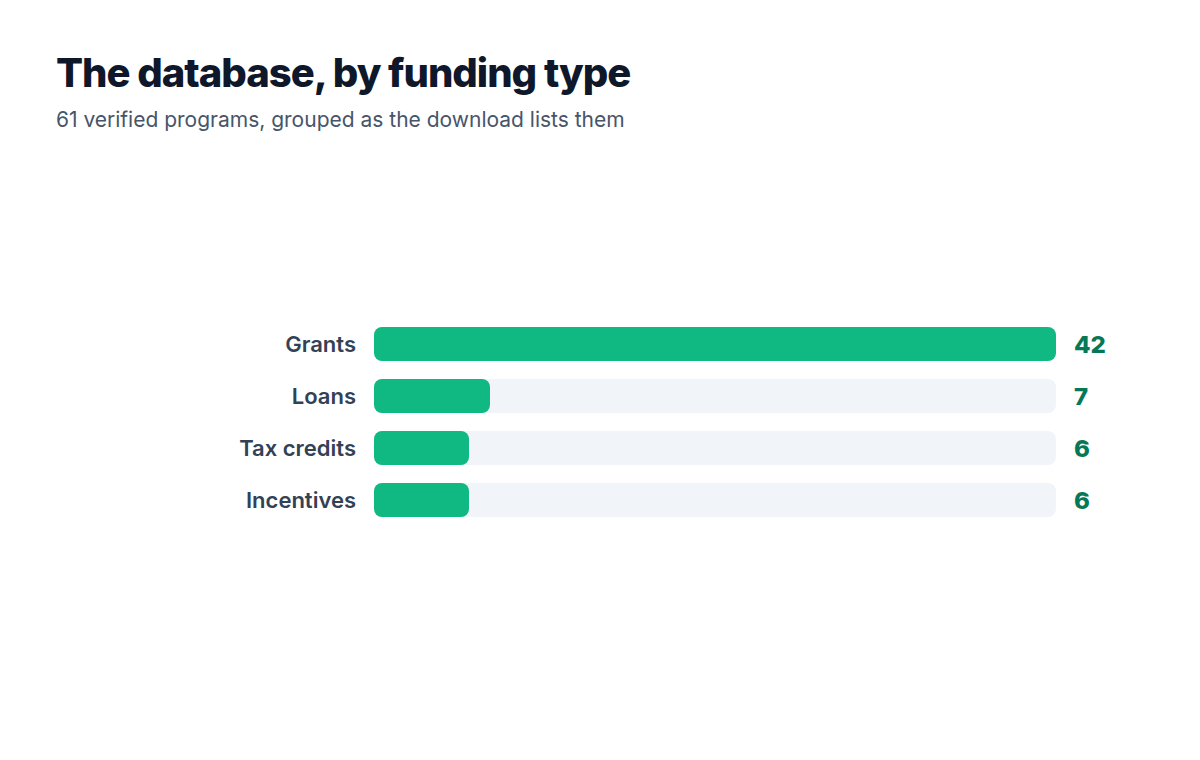
These are real programs, drawn from the 61 in our database, and each one has a specific door you have to walk through.
- HOME Investment Partnerships (HUD Exchange) — funds acquisition and rehabilitation of affordable housing, administered by states and localities. Developers usually participate through a nonprofit or a community housing development organization rather than applying alone.
- Community Development Block Grant (HUD Exchange) — locally administered, which means the rules that matter are your city's or county's. Some localities fund acquisition and rehabilitation directly; most require a public benefit case.
- Section 108 (HUD Exchange) — a loan guarantee that lets a locality borrow against future CDBG funds to finance an economic development project, which can include acquiring a site. It is debt, guaranteed rather than granted.
- USDA Single Family Housing (USDA Rural Development) — direct loans and repair loans and grants for households in rural areas. This is an owner-occupant program, not an investor program.
- USDA Multi-Family Housing (USDA Rural Development) — supports rural rental housing, typically through a nonprofit, public entity, or an owner willing to accept affordability conditions.
- State housing finance agency programs (NCSHA) — the state-level toolkit of tax credit allocation, tax-exempt bonds, gap loans, and soft seconds. This is where most acquisition subsidy in housing actually sits.
Notice the pattern: the money exists, and the applicant is usually an institution rather than an individual investor. If you want to use it, you either become the institution or you partner with one — and the partnership has to be real, because the public agency, not you, carries the compliance burden.
Can you get a grant for a down payment?
For an owner-occupant, sometimes, indirectly. USDA Single Family Housing direct loans in rural areas can reduce the cash you need at closing, and many state housing finance agencies run down payment assistance programs for buyers under income limits.
For an investor, treat "down payment grant" offers as marketing until proven otherwise. Most are loans, some are lead-generation, and the ones that are real are usually tied to occupancy requirements that an investment property cannot meet.
The reliable place to check is your state housing finance agency's program list — the same organizations that allocate housing tax credits also run the buyer-side programs.
So what actually funds an investment purchase?
Debt, equity, and seller terms — and then programs that reduce the cost of the asset after you own it.
- SBA 504 (U.S. Small Business Administration) provides long-term, fixed-rate financing for owner-occupied commercial real estate, which is the closest thing to a "buy a building" program most small operators can actually use.
- SBA 7(a) (U.S. Small Business Administration) covers working capital and can include real estate components, with eligibility tied to the business occupying the property.
- Local incentives — tax increment financing, abatement, and infrastructure support — are negotiated with your city and often decide whether a purchase pencils.
- Cost-reduction programs after closing: utility rebates through DSIRE, C-PACE financing for efficiency and resilience work, and the federal historic rehabilitation credit on a qualifying older building.
That last group is where most investors find real money, because it attaches to the building's performance and history rather than to the transaction itself.
The short version
There is no federal grant that hands an investor cash to buy real estate. Acquisition subsidy runs through housing and community development programs, and those programs are open to governments, nonprofits, and developers who partner with them on a public purpose. Everything else is debt — the honest question is which debt, at what cost, and what you can do afterwards to reduce your basis.
Read how grants differ from loans and tax credits before you build a capital plan, and if you are buying to hold or flip, the investor guide covers where cost-reduction money actually sits.
Where to check this yourself
The primary sources behind this article are listed below. Program terms change, so confirm the current cycle and eligibility at the source before you rely on anything here.
- HUD Exchange — HOME Investment Partnerships — U.S. Department of Housing and Urban Development
- USDA Rural Development — Single Family Housing — U.S. Department of Agriculture
Both are maintained by the agency that runs the program, not by us.
The Real Estate Grant Stack is a $49 downloadable toolkit that maps the programs a property business can actually apply for, with an official link on every entry — so you can see which doors are open to you instead of guessing.