New Markets Tax Credit for Real Estate
GrantEstate · 5 min read
By Donato Stough, founder of GrantEstate in Flower Mound, Texas. Every program cited here links to its official source page — each was checked against the agency’s own site before it went in. More about why I built this →
The New Markets Tax Credit sends below-market capital to real estate projects in low-income census tracts. Developers never apply to the fund directly.
Short answer: The New Markets Tax Credit (NMTC) gives investors a federal tax credit for putting money into a Community Development Entity, which then lends to or invests in projects in low-income census tracts. Developers never apply to the CDFI Fund directly. You get below-market capital; the tax credit belongs to the investor.
The New Markets Tax Credit is the largest source of non-dilutive capital most developers have never used, and the reason is structural rather than competitive: it is not designed to be applied for by the person building the project.
If you have heard that NMTC money is impossible to get, the more accurate statement is that it is impossible to apply for in the way you apply for a grant. Understanding the actual mechanic is what makes it usable.
Who actually applies for NMTC?
Certified Community Development Entities — CDEs — apply to the CDFI Fund for an allocation of tax credit authority. Those CDEs then deploy the capital into projects by making below-market loans or investments.
You, as the developer, work with a CDE. You do not file an application to the CDFI Fund, and nothing you do alone will produce NMTC capital. Your job is to make your project the kind of thing a CDE can take to its investment committee.
That means knowing what CDEs are active in your market and what they are chartered to do — some focus on housing, some on community facilities, some on business lending. The CDFI Fund publishes the list of certified CDEs, and the CDFI Program page explains the wider family of funds these organizations use.
What size project does NMTC suit?
Larger than most first-time developers expect.
The structure carries real transaction costs — legal work, accounting, closing, and the CDE's own underwriting — and those costs do not shrink proportionally on a small deal. Our own database entry records that projects much below roughly $5,000,000 in total cost are usually too small to justify the structure, and that individual project leverage commonly falls in the range of about $3,000,000 to $20,000,000.
If your project is a $900,000 duplex, NMTC is the wrong tool and a CDE will tell you so quickly. If you are putting together a $12,000,000 mixed-use building in a qualified census tract, it is worth the phone call.
What does NMTC capital actually cost you?
Less than equity, more in effort than a bank loan.
You receive a below-market loan or investment, which reduces your cost of capital and can fill a gap that a conventional lender will not close. In exchange, you accept a slow, document-heavy process with a partner whose return comes from the tax credit rather than from your project.
Two practical warnings from our database entry. First, NMTC allocations are awarded to CDEs in periodic competitive rounds, so the timing of available credit authority is outside your control — verify the current status before you build a schedule around it. Second, this is a tax credit, not a grant, so nothing about it should be described to your lender or your investors as free money.
How does NMTC compare with historic credits and Opportunity Zones?
They do different jobs, and the honest answer is that sophisticated deals stack them.
- The federal historic rehabilitation credit attaches to a certified historic building and offsets tax on the rehabilitation — it is about what the building is, not where it sits.
- Opportunity Zones are a capital gains incentive for investors, and the benefit accrues to the investor rather than to you as the developer.
- NMTC delivers capital to the project through a CDE, in a qualifying low-income census tract, at a scale that suits mid-sized and large deals.
A single adaptive-reuse project in a low-income tract can plausibly involve a historic credit, NMTC capital, and Opportunity Zone equity, each doing a different part of the work. That is also why these deals have expensive professional advisers — and why the fees are usually justified by the capital they unlock.
The short version
The New Markets Tax Credit is a federal tax credit that produces below-market capital for real estate in low-income census tracts, deployed through Community Development Entities rather than through applications from developers. It is competitive, it is administratively heavy, and it is usually only worth the effort on projects of several million dollars or more. Used properly, it is one of the few genuinely large sources of non-dilutive capital available to a commercial project.
Before you call a CDE, read how real estate grants work and how grants differ from tax credits and loans, because a tax credit disguised as a grant in a pitch deck is a problem you do not want to inherit.
Where to check this yourself
The primary sources behind this article are listed below. Program terms change, so confirm the current cycle and eligibility at the source before you rely on anything here.
- CDFI Fund — New Markets Tax Credit Program — U.S. Department of the Treasury
- CDFI Fund — all programs — U.S. Department of the Treasury
Both are maintained by the agency that administers the program, not by us.
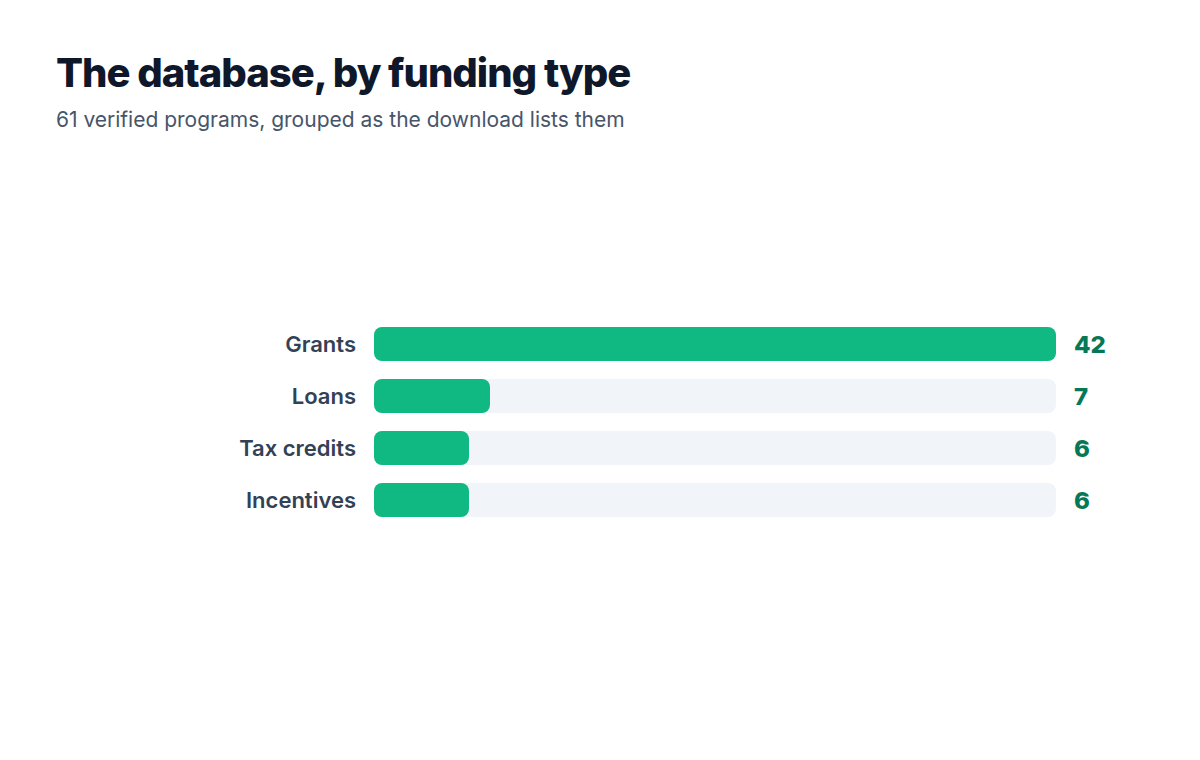
The Real Estate Grant Stack is a $49 downloadable toolkit that maps 61 real estate programs, including NMTC, the historic credit, and Opportunity Zones, with eligibility spelled out and an official link on every entry.